


Updated November 11, 2025
TL;DR: Hiring or outsourcing sales appointment setters involves significant direct and indirect costs that often lead to unpredictable ROI. These include salaries ($60,000 to $175,000 total compensation), benefits, technology subscriptions, and high turnover expenses. Companies spend an average of $1,252 per employee on training alone, and replacing an SDR can cost 1.5 times their annual salary. Add the fact that SDRs spend most of their time on non-selling activities, and ROI becomes unpredictable. For B2B Sales Leaders, Instantly offers a system-first approach to meeting generation with unlimited accounts, built-in warmup across a 4.2M+ account deliverability network, and AI automation, providing a more predictable, scalable, and transparent path to booked meetings at a lower cost per meeting. This guide breaks down traditional costs and shows how a platform can deliver consistent pipeline health without the hidden overheads.
Your sales team needs more meetings. But what's the real cost of getting them? Beyond salary, appointment setters require benefits, tools, training, and management time that add $20,000 to $30,000 per person annually and erode your cost per meeting. The quarter is tight, and pipeline health is critical. Before you commit to hiring another appointment setter or signing with an agency, let's break down the true financial impact and explore a more scalable, auditable path to booked meetings.
For B2B Sales Leaders managing teams of 3 to 15 reps with quota accountability, the decision to hire or outsource appointment setters often comes with a complex web of direct and indirect costs, making true ROI difficult to calculate and manage.
What is the true cost of a sales appointment setter?
The financial commitment behind each appointment setter extends far beyond the monthly paycheck. Sales leaders must account for multiple cost layers that compound quickly, especially as teams scale.
Direct costs: Salary and commission
In-house B2B sales appointment setters, typically called Sales Development Representatives (SDRs), command substantial compensation. According to BuiltIn salary data, the average base salary ranges from $50,000 to $70,000 across the United States. Total compensation including commissions and bonuses typically falls between $80,000 and $125,000 annually.
Experience dramatically affects these numbers:
- Entry-level (0-2 years): Total compensation ranges from $60,000 to $90,000 annually. For SDRs with no prior experience, base salaries typically start between $45,000 and $65,000, with On-Target Earnings (OTE) of $70,000 to $90,000.
- Mid-level (3-6 years): Total compensation increases to $90,000 to $110,000 annually. According to Bravado compensation data, Mid-Market SDRs with this experience average $102,800 in total compensation.
- Experienced (7+ years): Senior SDRs command $100,000 to $175,000 in total compensation, with average base salaries reaching $85,092 for those with 7+ years of experience.
Location significantly impacts these ranges. San Francisco SDRs average $90,000 to $140,000 OTE according to ZipRecruiter data, while New York City packages range from $90,000 to $130,000 OTE.
Commission structures add another layer of complexity. Most SDRs receive compensation through a base salary plus commission model, where the base represents 50% to 80% of total pay. Common commission structures include a fixed amount per booked meeting, a percentage of pipeline generated, or tiered plans where payout rates increase at higher performance thresholds.
Watch how Instantly's AI Copilot can give you an entire sales team on demand:
Indirect costs: Benefits, tools, and management overhead
The salary line item represents only the starting point. Each hire triggers a cascade of indirect expenses:
- Benefits and payroll taxes: Beyond base compensation, employers must budget for health insurance, paid time off, retirement contributions, and payroll taxes. Glassdoor reports that average cost-per-hire exceeds $4,000, with some reports suggesting figures up to $7,645 when all factors are considered.
- Training and ramp-up: New hire training programs require substantial investment in curriculum development, trainer time, and reduced productivity during the learning period. Most organizations report the typical SDR ramp-up period spans 3 to 6 months before new hires reach full quota attainment. This productivity gap can lead to substantial revenue losses during the initial months.
- Management overhead: A portion of a sales manager's salary and time is dedicated to coaching, one-on-one meetings, and performance reviews. This indirect cost per appointment setter often consumes significant managerial resources that could otherwise focus on strategic initiatives.
- Turnover costs: The sales profession, particularly for entry-level roles, experiences high attrition. Replacing an SDR can cost 1.5 times their annual salary according to Growleady analysis, factoring in recruitment, training, and lost opportunities from vacant positions, potentially totaling $100,000 per lost salesperson.
Outsourcing costs: Agency fees and hidden charges
Outsourcing presents a different cost structure. Common models include pay-per-appointment pricing outlined in the Everstage SDR compensation guide, with qualified meetings ranging from $30 to $150 each. Monthly retainers run $500 to $15,000 per month depending on volume. For specialized or sales-qualified meetings in complex B2B environments, costs can reach $200 to $1,000+ per appointment.
Many agencies charge initial setup fees for platform configuration, tool integration, and onboarding. Hidden charges may include costs for data management, lead quality assurance, and compliance measures. The challenge with outsourcing lies in maintaining control over deliverability, data quality, and brand voice, all while navigating variable performance that may not align with internal quality standards.
How to calculate the ROI of your appointment setting efforts
Without precise ROI measurement, you're flying blind on one of your most critical pipeline drivers.
Defining key metrics: Meetings set, SQLs, and closed-won deals
Start by establishing clear definitions for each funnel stage. Track the number of appointments set as your volume metric. This raw number tells you capacity. Measure the appointment show rate (percentage of scheduled meetings that actually occur) to assess lead quality. If show rate drops below 60 percent, your targeting or qualification is off.
Calculate your lead qualification rate by tracking how many appointments meet your ICP criteria and become sales-qualified leads (SQLs) as detailed in this Varicent guide. This percentage reveals whether you're burning rep time on junk meetings.
The most critical metric is your conversion rate from appointment to closed-won deal. This percentage directly links appointment setting efforts to revenue and reveals the true value of each booked meeting. Strong B2B sales ROI typically falls between 3:1 and 5:1 according to Repvue salary data, meaning every dollar invested should generate three to five dollars in return.
Additional metrics provide deeper insight:
- Cost per Appointment (CPA): Total spend divided by total booked meetings
- Customer Acquisition Cost (CAC): Total cost to acquire a new customer through appointment setting
- Revenue per Appointment: Average revenue generated from each appointment
- Lead-to-Appointment Ratio: Percentage of leads converted into scheduled appointments
The ROI formula: Revenue generated vs. total cost
The fundamental ROI calculation follows this structure:
ROI = ((Net Profit from Sales from Appointments - Cost of Appointment Setting) / Cost of Appointment Setting) x 100
To derive this accurately:
Step 1:
Sum all costs associated with appointment setting. For in-house teams, include salaries, benefits, recruitment, training, technology subscriptions, management time, and office overhead. For outsourced services, include all service fees, setup charges, and data management costs.
Step 2:
Calculate revenue from appointments. Multiply the number of qualified leads or appointments that converted into sales by your average deal size. For a more accurate long-term view, factor in customer lifetime value (LTV).
Step 3:
Determine net profit by subtracting total appointment setting costs from the revenue generated by those appointments.
Real scenario for a 50-person B2B SaaS company: You invest $88,600 annually for one fully-loaded SDR who books 240 qualified meetings per year (20 per month). Your sales team closes 15 percent of those meetings at an average deal size of $18,000. That SDR generates $648,000 in closed revenue. ROI is 632 percent or 7.3:1, which looks strong.
Now run the same model with Instantly pricing at $2,880 annual cost (Hypergrowth plus SuperSearch Growth). Same 240 meetings, same 15 percent close rate, same $18,000 ACV yields $648,000 revenue. ROI jumps to 22,400 percent or 225:1. The difference is $85,720 in freed capital you can deploy to product, hiring AEs who close bigger deals, or simply better unit economics that survive a down quarter.
"Instantly has been a game changer for my vertical in merchant service where email marketing is key. I've converted several leads into deals using Instantly and it's paid for itself 5x." - Philip Hendrich on Trustpilot
The hidden costs and risks of human appointment setters
Beyond the line items on your P&L, human appointment setter teams carry operational risks that directly impact pipeline health and revenue predictability.
Deliverability challenges and domain health risks
Email deliverability represents the foundation of successful cold outreach. When SDRs send from poorly warmed domains, use low-quality contact data, or exceed safe send volumes, they risk damaging your sender reputation. A single rep sending too aggressively can land your entire domain on a blocklist, cutting off primary inbox placement for your whole team.
Inconsistent performance and training overhead
SDR performance varies dramatically based on skill, motivation, coaching quality, and territory assignment. Top performers may book 2-3 times more meetings than average reps, creating unpredictable pipeline flow that complicates forecasting and resource planning.
When reps leave, you lose not only their productivity but also their accumulated knowledge of your ICP, messaging frameworks, and prospect interactions. Knowledge transfer is rarely complete, forcing new hires to rediscover lessons their predecessors already learned.
Scalability limits and per-seat pricing traps
Traditional models tie costs directly to headcount. Adding capacity means hiring more SDRs, which triggers the full cascade of recruitment, onboarding, technology provisioning, and management overhead. If each SDR costs $88,600 fully loaded and takes 4 months to ramp, scaling from 5 to 10 SDRs requires $443,000 in new annual investment plus 4 months of reduced output. Multiply this across 4 to 6 tools in your stack, and per-seat pricing creates a scalability tax that increases faster than revenue.
Data quality concerns
Lead quality directly impacts conversion rates and cost per acquisition. When SDRs work from stale or inaccurate contact lists, bounce rates climb, sender reputation declines, and appointment show rates drop. Manual list building and data enrichment consume significant SDR time, often with inconsistent quality standards across team members.
How Instantly changes the economics of B2B meeting generation
Instantly approaches meeting generation as a system rather than a headcount problem. By combining deliverability infrastructure, data access, and AI automation into a unified platform, it shifts the cost structure from variable per-person expenses to predictable monthly fees.
Unlimited accounts and built-in warmup for predictable deliverability
Instantly includes unlimited email accounts and automated warmup on all plans, starting at $37 per month for the Growth tier. This removes the per-mailbox charges that traditional platforms impose and enables sophisticated inbox rotation strategies without additional cost.
The platform's private deliverability network spans 4.2M+ accounts that participate in mutual warmup activities. This network effect helps new sending domains build reputation faster and maintain consistent primary inbox placement at scale. For teams on the Light Speed plan ($358 per month), Server & IP Sharding & Rotation (SISR) with dedicated IP pools provides additional deliverability control for high-volume sending.
Watch our deep dive on deliverability in 2025:
"I like that instantly can handle large scale email campaigns without worrying about deliverability. The automation for inbox rotation, warm up and sending limits makes outreach very smooth and saves a lot of manual work." - Anjali T. on G2
SuperSearch: Integrated lead generation at scale
SuperSearch provides access to 450M+ B2B leads directly within the platform, eliminating the need for separate data provider subscriptions. Waterfall enrichment pulls from 5+ data sources to maximize contact coverage and accuracy. LLM-assisted enrichment helps identify high-fit prospects based on your ICP criteria.
The credits-based pricing model starts at $9 per month for 150 credits (Nano plan) and scales to enterprise levels. For most B2B sales teams, the Growth plan at $47 per month provides 1,500 to 2,000 credits. Compare this to standalone data providers that charge $99 to $299 per user per month with monthly minimums, and the savings compound as you add team members.
Integration with campaign creation means you can move from prospect search to email sequence launch without context switching or data exports. This reduces the administrative burden that typically consumes SDR time and introduces opportunities for data quality issues.
See how SuperSearch delivers you qualified leads on demand below:
AI agents: Automating replies and reducing manual workload
Instantly's AI Reply Agent handles inbound lead responses in under 5 minutes, automatically categorizing replies and drafting contextually appropriate responses. You can configure the agent for Human-in-the-Loop review, where you approve each response before it sends, or full Autopilot mode for lower-risk scenarios like meeting confirmations and out-of-office replies. Integration with Slack enables quick approval workflows, so you maintain control without monitoring the platform constantly.
Copilot serves as an in-app assistant for campaign creation, lead targeting, analytics interpretation, and recurring operational tasks. By automating research, template generation, and performance analysis, Copilot reduces the expertise gap between junior and senior SDRs. This accelerates ramp time for new team members and standardizes quality across campaigns.
Transparent, flat-fee pricing: No per-seat penalties
Instantly's pricing structure separates outreach capacity from team size. The core Outreach plans (Growth at $37/month, Hypergrowth at $97/month, Light Speed at $358/month) include unlimited email accounts regardless of how many people access the platform. This removes the scalability tax that per-seat models impose.
You can add CRM capabilities starting at $47 per month (Growth CRM) or $97 per month (Hyper CRM with calling and SMS). SuperSearch adds $47 per month for most teams. A typical full-stack configuration (Hypergrowth Outreach + SuperSearch Growth + Growth CRM) runs $191 per month, compared to $88,600+ annual cost for a single fully-loaded SDR.
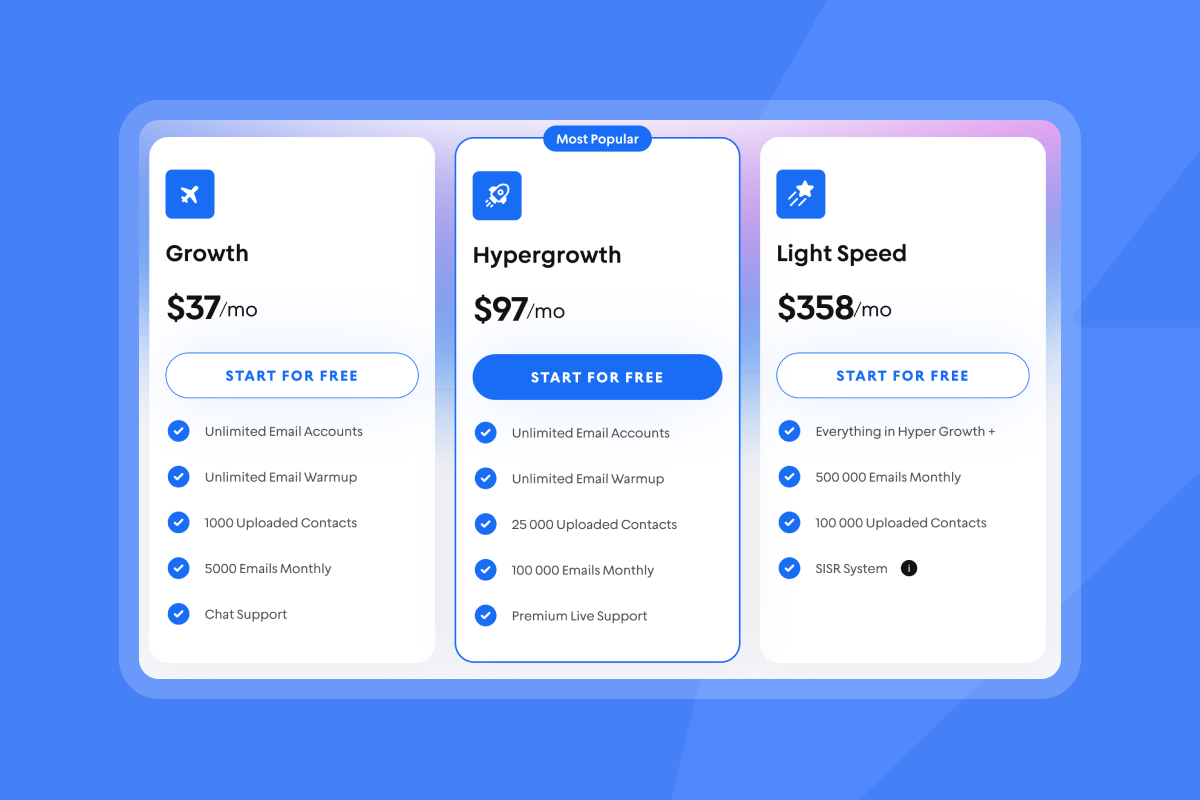
The modular approach means you pay only for the capabilities you use. If your team already has a CRM you want to keep, skip that module and integrate via native CRM connectors for two-way sync. For other systems like Pipedrive or custom databases, use Zapier or Make to automate handoffs.
Annual billing provides additional discounts (Growth drops from $37 to $30 per month, Hypergrowth from $97 to $77.60 per month).
System-first approach: Auditable processes and consistent results
Rather than relying on individual SDR judgment and consistency, Instantly embeds best practices into the platform architecture. Global block lists, reputation protection, and bounce detection operate automatically across all campaigns. Send window scheduling and volume pacing prevent individual users from making mistakes that damage domain health.
Campaign analytics and A/Z testing provide clear visibility into what's working. Managers can review performance across campaigns, identify top-performing messaging, and replicate success systematically rather than relying on individual SDR discovery. Integration with CRM systems via webhooks and API enables automated reporting that reconciles with broader sales metrics.
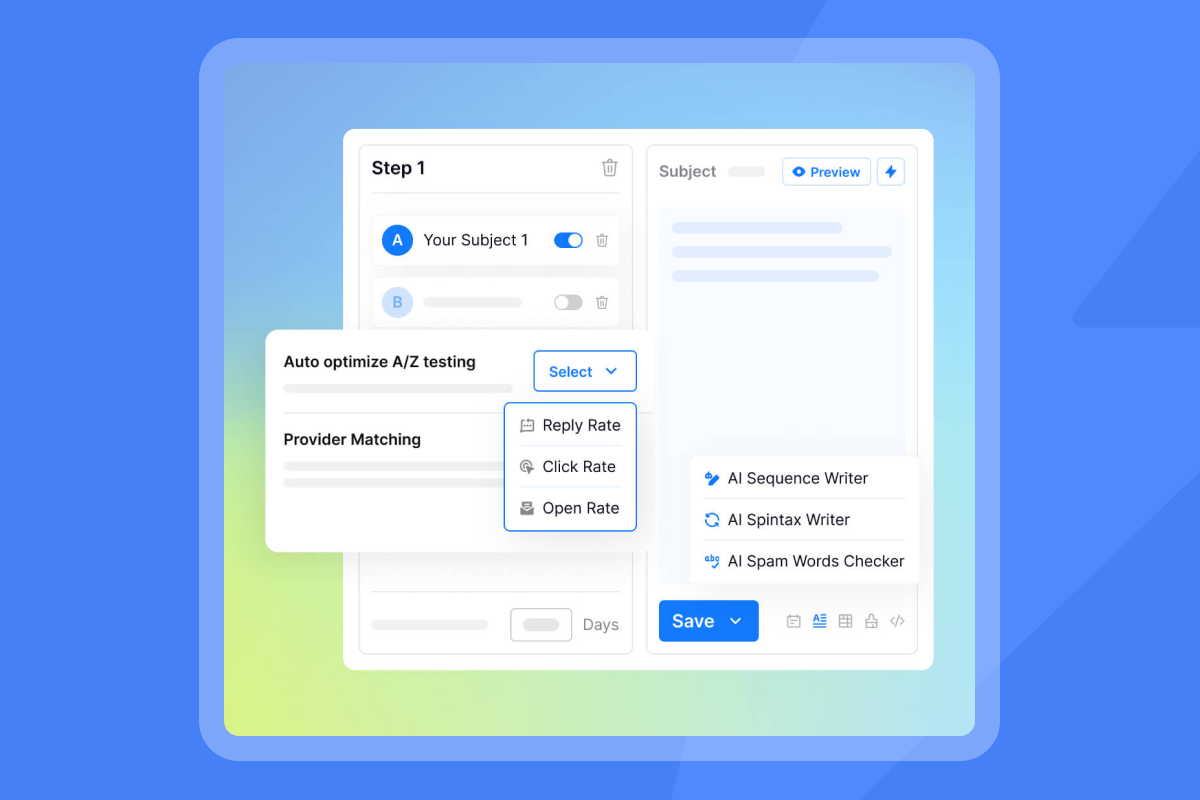
The Unibox centralizes all replies in a single interface, preventing the context switching that fragments SDR attention. Tasks and follow-up reminders ensure no conversation falls through the cracks. This structure reduces the variability that plagues human-dependent processes and makes performance more predictable across your entire operation.
Reporting that reconciles with CRM
Your biggest analytics fear is dashboards that don't match CRM reality. Instantly provides webhook and API integrations that push every sent email, open, reply, and meeting into your system of record.
Bounce tracking, spam placement scores, and reply classification are timestamped and exportable. If a number looks wrong, you can drill into the raw event log and verify it yourself. This audit trail is what survives board reviews and renewals.
"The platform is simple to set up, highly scalable, and ensures strong deliverability with features like smart sender rotation and built-in warm-up. We've been able to manage multiple domains and email IDs seamlessly, which has boosted both our reach and response rates." - Sumit Nautiyal on Trustpilot
For a comprehensive walkthrough of platform capabilities, watch this Instantly AI tutorial video.
Calculate your Instantly ROI today
Ready to compare platform economics to your current appointment setting costs? Start a free trial of Instantly and run a 30-day proof of concept alongside your existing approach. Set up two campaigns with real domains, work through the 30-day warmup protocol, and track meetings generated against total investment.
For additional context on total cost of ownership across sales engagement platforms, read our cold email & sales engagement TCO & ROI guide or compare pricing ROI vs. alternative platforms in our Instantly pricing ROI analysis.
FAQs:
What is the typical all-in cost for an in-house sales appointment setter?
A fully-loaded in-house SDR costs $77,400 to $99,800 annually when you include base salary ($60,000 to $70,000), benefits and overhead ($15,000 to $25,000), and technology subscriptions ($2,400 to $4,800). Add recruitment costs averaging $4,000 to $7,645 per hire, plus the 3 to 6 month ramp period when productivity is below target. High-performing markets like San Francisco see total compensation packages reach $140,000+.
How long does it take for a new SDR to become fully productive?
The typical ramp period for a new SDR is 3 to 6 months, with most organizations reporting significant time investment in training and coaching before quota attainment. During this time, you pay full compensation while receiving limited output. By contrast, an Instantly campaign can launch in 2 to 3 days after domain setup and warmup start, with first meetings often booked within the first week of active sending.
What metrics should I track to calculate appointment setting ROI accurately?
Track number of appointments set, appointment show rate (percentage that occur), lead qualification rate (percentage meeting ICP criteria), and conversion rate from appointment to closed-won deal. Calculate cost per appointment (total spend divided by meetings booked), customer acquisition cost (total cost per new customer), and revenue per appointment (average deal size times close rate). Strong B2B sales ROI typically ranges from 3:1 to 5:1, meaning every dollar invested should return three to five dollars.
How does outsourced appointment setting pricing compare to in-house costs?
Outsourced services typically charge $30 to $150 per qualified appointment, with specialized B2B meetings potentially costing $200 to $1,000+. Monthly retainers range from $500 to $15,000 depending on volume and complexity. At 20 meetings per month, a $150 per-meeting rate totals $36,000 annually, compared to $88,600 for an in-house SDR. However, outsourcing offers less control over process, messaging, and data quality.
Key Terminology Glossary
Sales Development Representative (SDR): A sales role focused exclusively on outbound prospecting and appointment setting, typically passing qualified leads to Account Executives for closing.
On-Target Earnings (OTE): Total compensation an SDR can expect when meeting performance targets, including base salary plus commissions and bonuses.
Cost per Appointment (CPA): Total investment in appointment setting divided by the number of booked meetings, measuring financial efficiency of lead generation efforts.
Sales Qualified Lead (SQL): A prospect who has been vetted by sales development and meets specific criteria indicating readiness for direct sales engagement.
Primary Inbox Placement: The percentage of emails landing in the main inbox folder rather than spam, promotions, or other filtered locations.
Sender Reputation: A score assigned by email providers based on sending patterns, bounce rates, spam complaints, and engagement that determines deliverability.
Email Warmup: The process of gradually increasing send volume from new email accounts to build positive sender reputation before launching full campaigns.
Ramp-Up Period: The time required for a new SDR to reach full productivity, typically 3 to 6 months including training and initial performance building. Platform-based approaches can generate first meetings within 7 to 14 days after domain warmup.
Customer Acquisition Cost (CAC): Total sales and marketing expense required to acquire a new customer, including all appointment setting costs.
Deliverability Network: A shared pool of email accounts that exchange messages to build reputation and improve inbox placement for all participants.


