


Modern AI sales agent software consists of specialized, autonomous tools designed to execute specific sales tasks, not replace entire teams.
Top platforms serve distinct functions: Instantly’s AI Reply Agent masters autonomous cold email conversation handling and lead qualification; Claygent specializes in deep, real-time lead research and enrichment; Agentforce integrates directly into Salesforce for automated CRM workflows.
Choosing the right agent hinges on identifying your precise operational bottleneck, be it lead research, outbound response management, or internal data hygiene, and selecting the specialist built to solve it.
AI sales agents are having a moment, and the internet is full of “this will replace your SDR team” takes. The reality is that AI sales agents are becoming exceptional at what they do, whether that’s identifying your ideal customers, prospecting, qualifying, or engaging with leads.
However, AI agents aren’t cheap. Get the wrong one, and you might end up with a glorified chatbot or an email bot sending spam.
After all, going the agentic route won’t fix a sales team with a bad process. So, how can you genuinely tell whether an AI sales agent software is worth the investment? And which agents are worth considering in 2026 and beyond? We break it all down below.
Are AI Sales Agent Software Worth The Investment?
If you want the real answer, ignore the hype and look at ROI. Will an AI sales agent actually create revenue, or will it just generate more noise? There’s precedent for this working at scale.
Jason Lemkin of SaaStr has discussed shifting from an 8- to 9-person go-to-market team to 1 to 2 humans and 20 AI agents, including an agent that closed a $70k sponsorship on its own.
However, for most businesses, replacing an entire team is not the goal. AI sales agents are still tools, and tools only yield ROI when they’re directed at a specific bottleneck and utilized as a system. If you want to know if these tools are worth it for your needs, here’s what you should consider:
Does the AI Sales Agent Make Sense for Your Workflow?
Before comparing features, consider the realities. An agent only produces ROI when it aligns seamlessly with how you already sell.
Here’s how you can test workflow fit:
- Start with the bottleneck: Where does revenue currently get stuck?
- Define the agent’s “job description” in one sentence: If you can’t explain what the agent does without listing features, it’s not scoped.
- Know where it lives in your workflow (and where it doesn’t): Will it focus on inbound leads or outbound prospecting, qualification, follow-up, or pipeline hygiene?
- Audit the inputs it needs to do good work: If your data is scattered, outdated, or inconsistent, the agent will mirror that mess perfectly, at scale.
- Decide the handoff moment: When does the agent stop, and a human takes over?
What’s the Level of Autonomy and Control?
Automation is the whole appeal of an AI sales agent, but the “fully autonomous” version is also the easiest way to create brand risk. The real question is where you want the agent to run on its own, and where you want a human to step in.
Instantly has a Human-In-The-Loop (HITL) setup for this. With the AI Reply Agent, you can run it in triage-only mode, meaning the AI classifies and organizes replies, but a human rep manually sends the actual response.
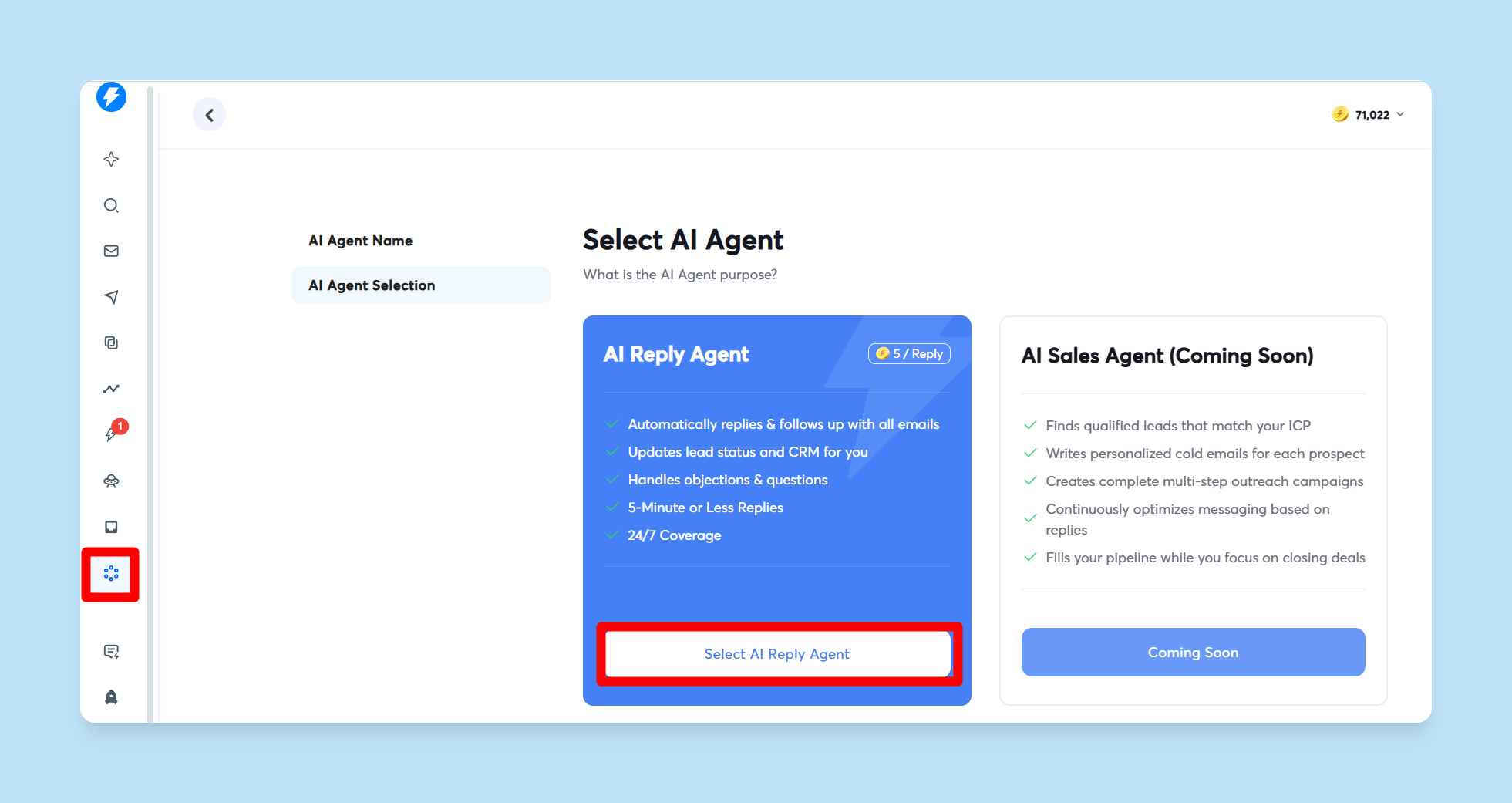
When the rep takes over, they can still keep everything tight:
- Choose which email address to send from
- Change reply-to addresses if needed
- Craft a personalized response
- Handle complex conversations that need real judgment
How Fast Will the AI Agent Generate Value?
Speed matters because most AI sales agents don’t fail because they’re “bad.” They fail because the ramp time is longer than the team’s patience can endure. If you need weeks of training data, complex integrations, and constant prompt babysitting before it does anything useful, the ROI clock starts feeling imaginary.
The fastest path to value is when the agent can plug into a clearly defined bottleneck and produce a measurable win quickly, like faster speed-to-lead, more qualified meetings, or fewer leads slipping through follow-up.
Different Types of AI Sales Agent Software
AI sales agents can exist in every stage of the sales process. But you’ll rarely see one that covers the entire thing.
Different tasks need different types of AI sales agent software:
Prospecting and Enrichment Agents
These agents can pull context automatically. They can scan the web for recent company news, identify parts of a firm’s tech stack, generate clean company descriptions, and build richer lead profiles. Some even use your best customers as a reference, then surface lookalike companies.
Lead Scoring and Qualification Agents
A lead scoring and qualification agent is your always-on gatekeeper. It watches signals (who they are, what they did, what they asked), asks a few thoughtful questions, then routes the lead to the right next step.
Outbound Outreach Agents
There’s a fundamental difference between automation and agentic outbound. Automation runs the same play on a timer. Outbound outreach agents take context into account, pull from your company data, and adjust the offer, value prop, and even segment before they ever hit send.
Website Chat and Inbound Qualification Agents
An inbound qualification agent treats every visitor like a potential deal, captures the proper context, asks a few insightful questions, and guides them to the next step while they’re still on your site.
Calling and Voice Agents
Voice agents raise the stakes because they operate in real time. They can hold a live conversation, ask follow-up questions, handle basic objections, and move someone to the next step without a rep babysitting every line.
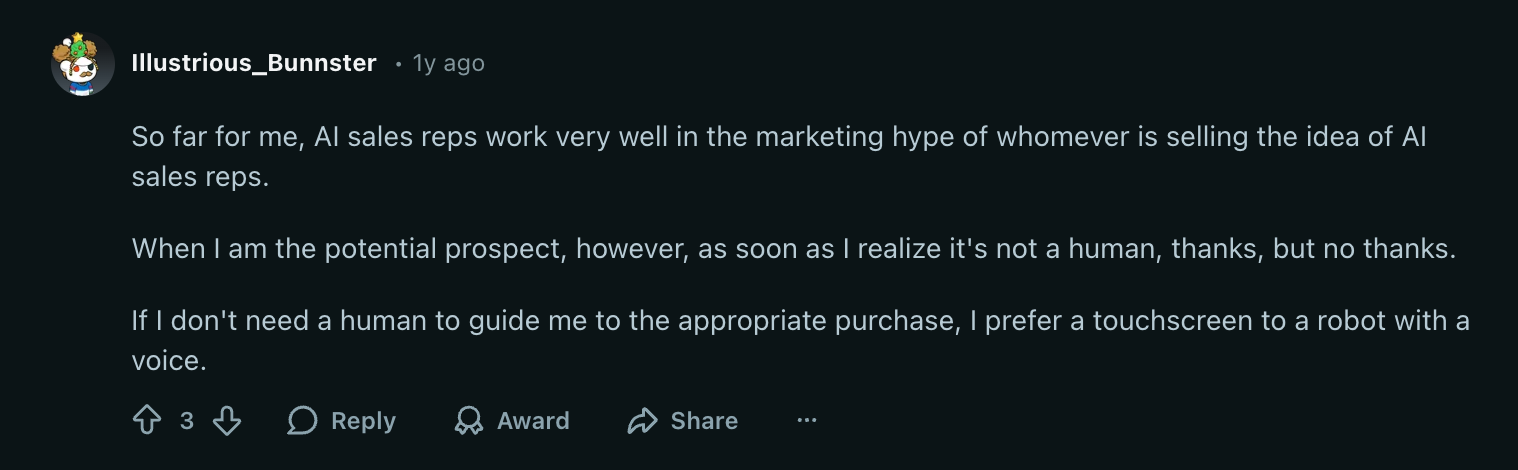
But if you’re the prospect, the moment you realize you’re talking to a bot, thanks, but no thanks to whatever it is you’re trying to sell. This Redditor sums it up nicely:
Pipeline and CRM Admin Agents
Pipeline and CRM admin agents keep your sales process tidy behind the scenes. They update fields and stages from calls, emails, and meeting notes, log key details, create follow-up tasks, and flag deals that are stuck or missing next steps.
Best AI Sales Agent Software Worth Investing In
There are hundreds of AI sales agent software on the market, each with its own set of pros and cons. And if you want something more custom, several platforms let you create your own custom agents even without any code. Here’s what we recommend:
Instantly.ai: Best AI Sales Agent Software for Cold Email Marketing
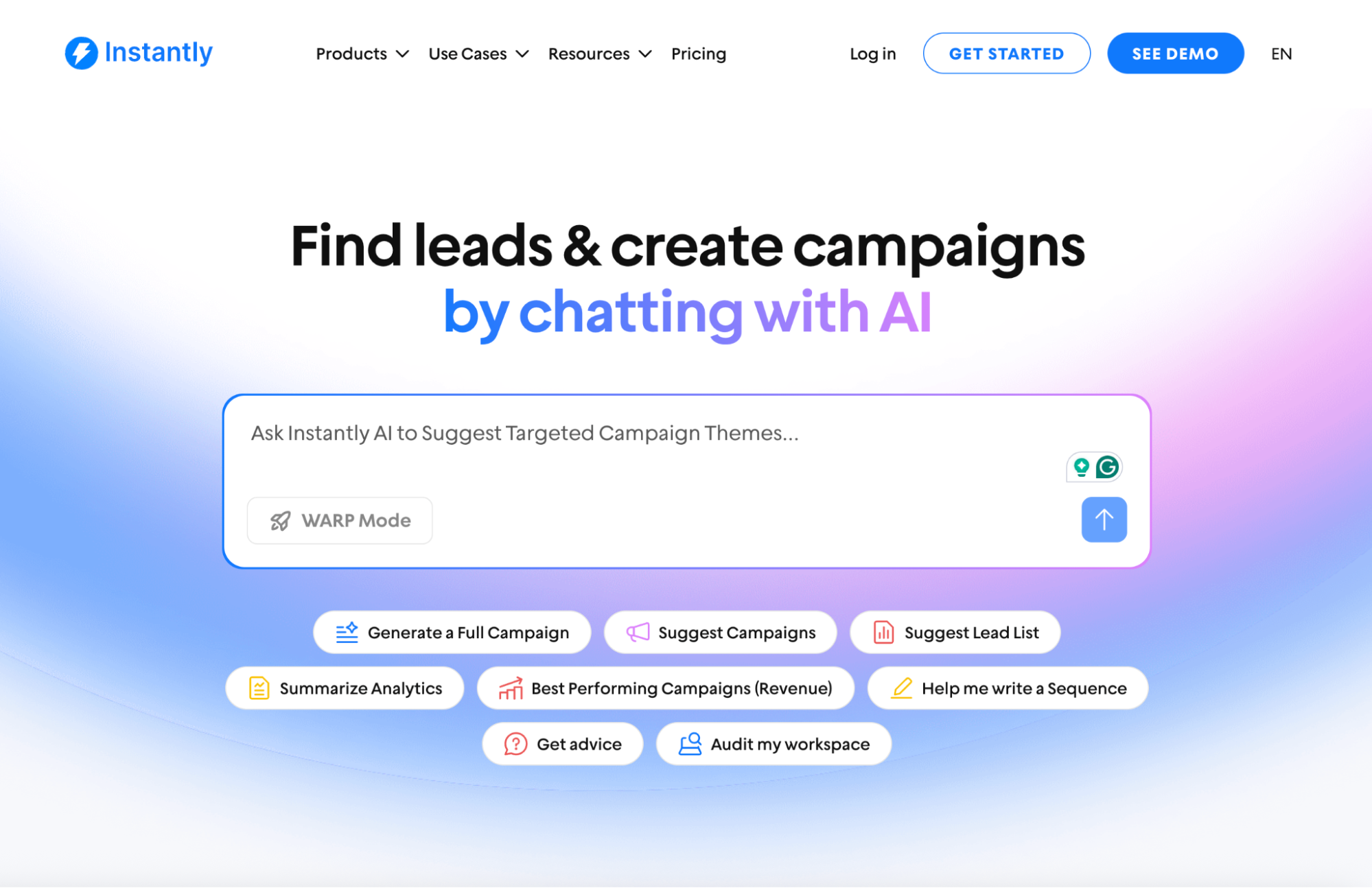
Instantly’s AI Reply Agent is built for the exact moment cold outreach starts working. You finally get replies, your inbox turns into a traffic jam, and the bottleneck shifts from “getting responses” to “handling responses fast enough to book meetings.”
The AI Reply Agent acts like a 24/7 support staff. It reads incoming emails from leads, replies on your behalf, handles common objections, sends follow-ups, shares calendar links, and automatically updates CRMs.
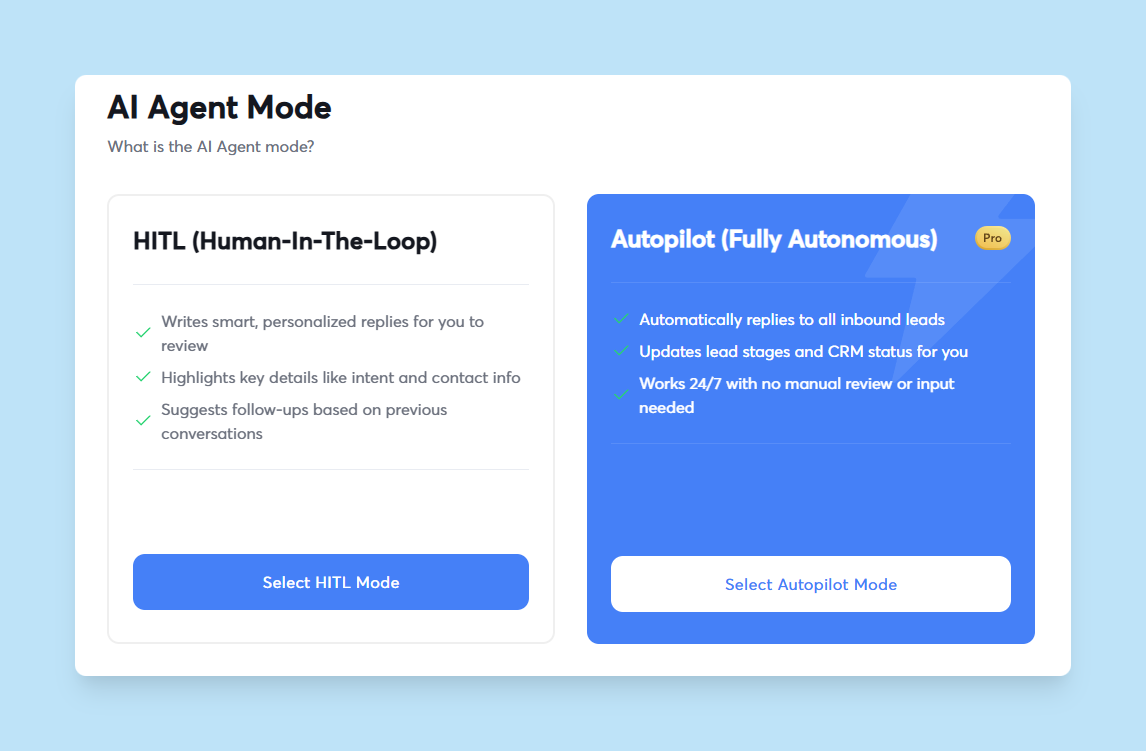
You can run it in two modes, depending on how much control you want:
- Human-in-the-Loop (HITL) is the safety-first option: the agent drafts replies, and you approve them before anything is sent out.
- Autopilot is for scale: it replies instantly without waiting on you, which is perfect when you’re dealing with high volume, or you’ve already dialed in your offer and workflows.
Autopilot also has guardrails. It avoids duplicate replies if you answer first, and it uses smart pausing: it only sends when it’s confident, and pauses for your review when context is missing or it’s unsure.
For teams scaling cold outreach, the main advantage is speed and consistency. Replies that sit for hours turn into missed meetings, and missed meetings turn into wasted sending volume.
With Autopilot, you keep momentum, book faster, and reduce the manual back-and-forth that drains your team. When conversations get complex, the agent can route them back to your team with Slack notifications and visibility in the Activity section, so humans can step in ASAP.
SalesCloser.ai: Full Stack Agentic Sales Engine
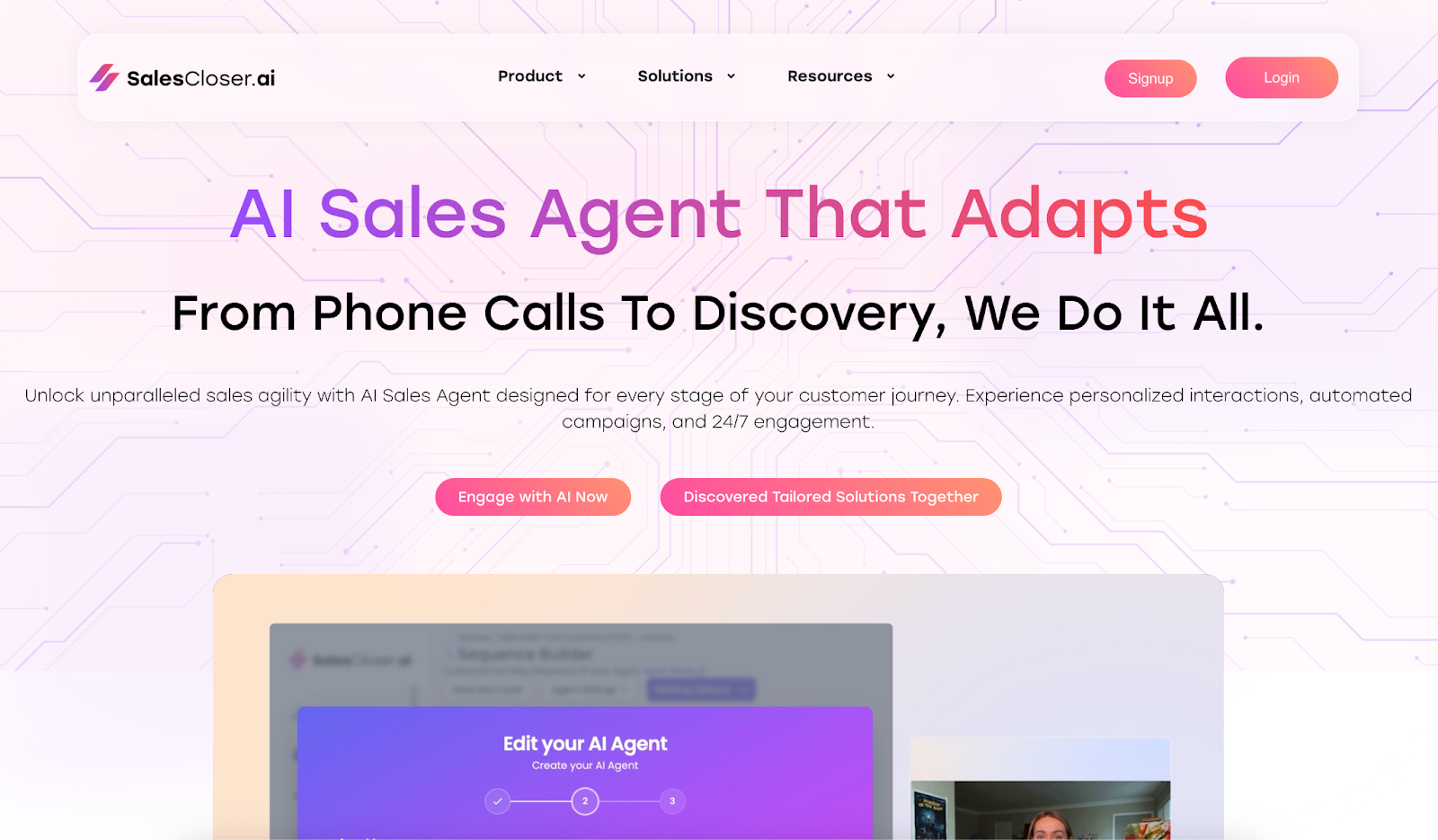
SalesCloser does it all, from prospecting to discovery, demos, onboarding, and support. But it’s also one of the most polarizing AI sales agents on the market. If you look at the reviews online, you’ll see a mix of people who really love the software or have strong issues with it.
Key Features:
- Qualification + lead handling: templates and use cases include automated qualification, appointment scheduling, follow-up campaigns, demos, and even support.
- Calls + “real conversation” workflows: their guides describe immediate outbound calls for high-intent leads, plus video calls (with screen share) for lightweight product tours.
- CRM hygiene by automation: they describe logging outcomes, transcripts, recordings, and summaries automatically (example shown via Pipedrive).
- Integrations: they list native-style integrations (HubSpot, Salesforce, Calendly, Gmail, Slack, etc.) and also appear in Zapier’s integration directory.
However, as you would expect, an AI sales agent of this comprehensive nature, with so many features, also comes with a premium price tag. Although there isn’t a pricing page listed on their site, third-party directories list pricing at around $900 to $1,000+. This gives you:
- 1 AI Sales Agent
- Custom Knowledgebase
- Demo Flow Editor
- Lead Capture Forms
- Call Analytics
- Lead Reporting
- Zoom and Phone Integration
Agentforce: Best Enterprise AI Sales Agent for Salesforce
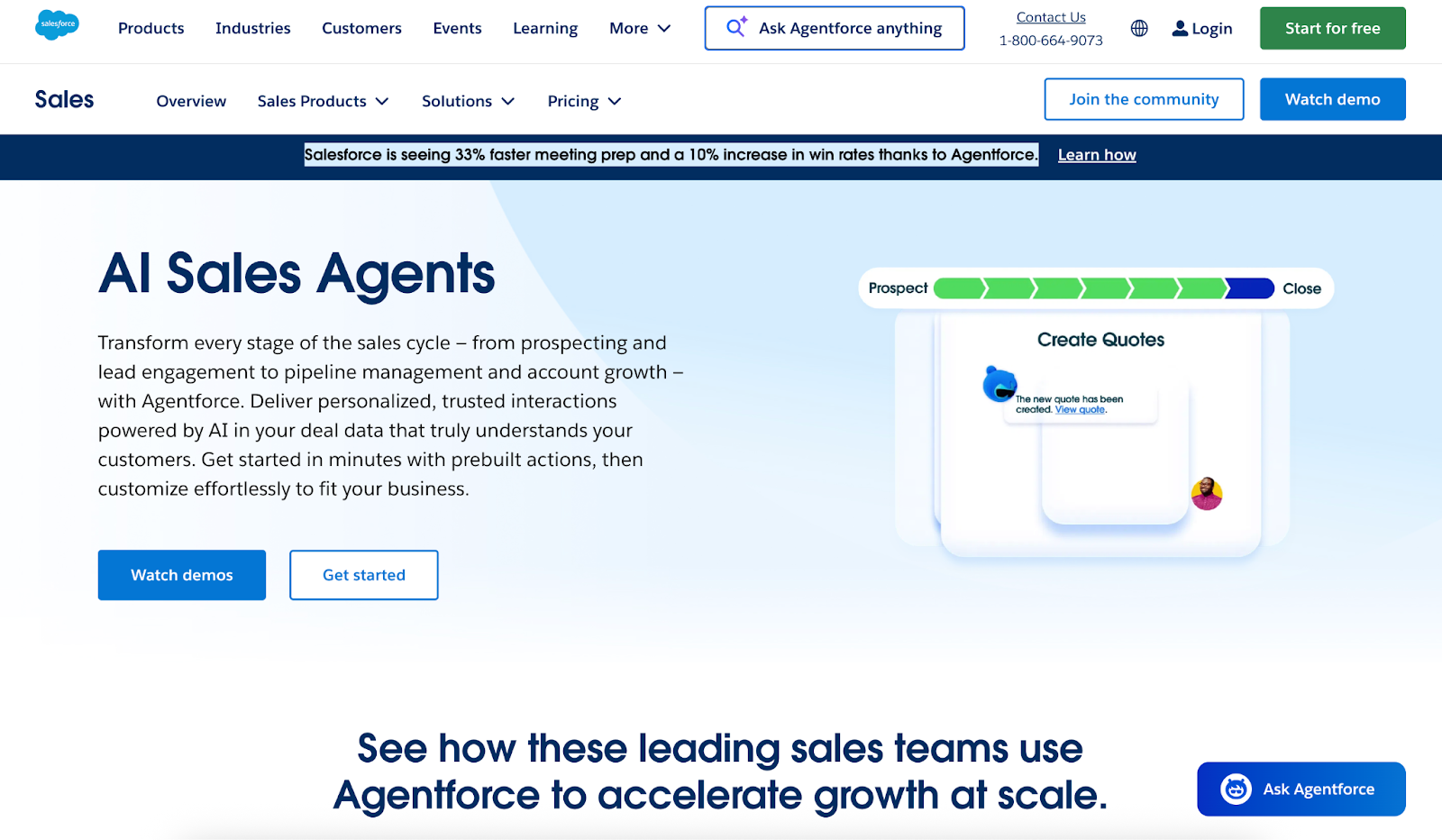
Salesforce is one of the leading CRMs in the market for good reason. It becomes the place where your pipeline, customer history, and internal processes all converge.
With the introduction of Agentforce, Salesforce is pushing that one step further by letting you build AI agents that can answer questions and take actions inside the same CRM workflows your team already uses.
First thing to make clear: Agentforce is not a standalone tool. You need a Salesforce org because Agentforce is part of the Salesforce Platform, and it runs with your Salesforce data access controls, permissions, and guardrails.
Key Features:
- Topics, actions, and instructions: the core way you control what an agent is supposed to do and what it is allowed to execute.
- Agent Builder + Prompt Builder + templates: Salesforce positions this as the “builder layer” with out-of-the-box topics/actions for customer-facing use cases.
- Atlas Reasoning Engine: Salesforce’s reasoning layer that helps agents choose actions step-by-step, plus built-in visibility into reasoning inside the builder canvas.
- Multi-channel operation: Salesforce highlights agents operating across channels, with Slack being a common “front door” for teams.
Claygent: Best for AI Research + Enrichment
Although Claygent doesn’t directly interact or engage with your prospect, it does something that’s all the more important and scalable.
Instead of opening 20 tabs to figure out what a company does, who they sell to, or whether they are hiring, you ask Claygent a question, and it returns an answer you can use as a field for list segmentation, personalization, or routing.
What makes it feel powerful is the builder layer. Claygent Builder is a workspace-level tool that allows teams to design, test, and version Claygents once, then reuse them across tables. You can iterate in the builder without spending credits, making it easier to refine your prompts.
Key Features:
- Last-mile enrichment from the live web: Claygent can browse websites, read pages, and return insights at scale, which is perfect for niche cases.
- Human-like web navigation for hard sites: Their Navigator can interact with sites by applying filters, filling forms, clicking buttons, and then pulling structured data.
- Claygent Builder: You can design, test, and version Claygents at the workspace level, preview reasoning, and update across every table.
- Native Instantly integration for outreach execution: Clay’s Instantly integration lets you add leads directly to campaigns (plus actions like find leads and verify email).
Artisan Ava: Full-Stack Outbound Platform With an AI BDR
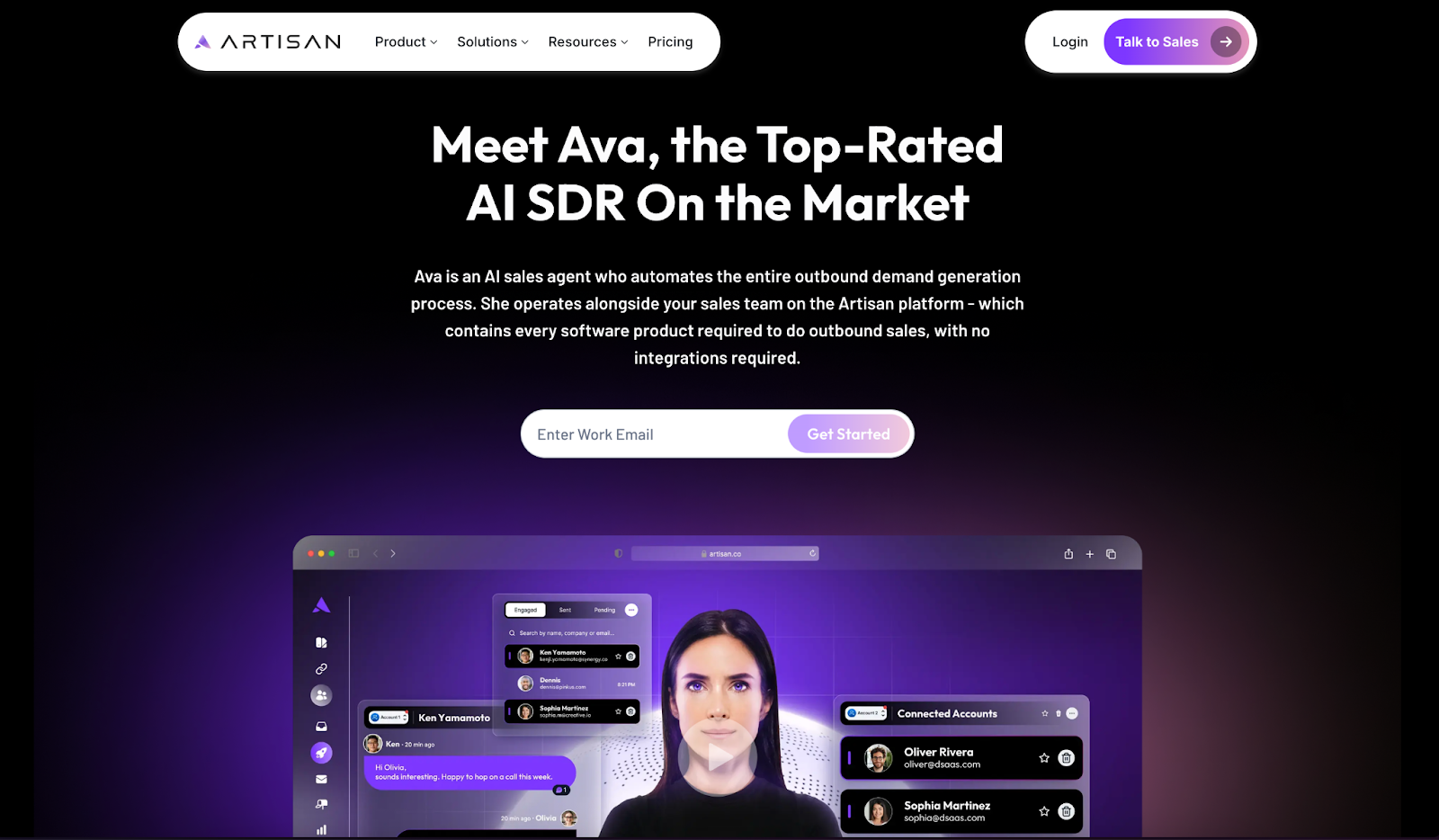
If you’re already using the Artisan platform, Ava is an AI BDR that can accelerate your team’s winning strategies. Ava is positioned to handle the SDR loop end-to-end within the Artisan platform, from identifying leads to researching them to executing multi-channel outreach.
Key Features:
- Lead database + verification: A built-in B2B database with 300M+ verified contacts, plus bounce testing and validation to help keep lists clean.
- Enrichment and signal mining: Pulls context from places like social activity, fundraising, company news, technographics, hiring signals, and press mentions.
- Personalization waterfall: A structured personalization flow that selects what to reference per prospect, with controls for tone and custom CTAs.
- Outbound sequencing: Drag-and-drop sequence builder with multi-channel outreach across email and social touchpoints.
- Deliverability suite: Warmup, mailbox health monitoring, placement monitoring, dynamic sending limits, and signature rotation built into the platform.
Key Takeaways
AI sales agents are different from automation for one reason: they can follow context. They read the thread, understand what the prospect is asking, and then take the next step using the tools you already use.
If cold emails are a significant part of your sales process, Instantly is built for that. Set up outreach, keep replies moving, and scale without your team being bogged down in the inbox. Want to see what it looks like on a real campaign? Try Instantly for free today.


