


One of the fastest ways to find new customers is a disciplined cold email marketing strategy.
For the best results, start with a solid infrastructure, use verified and enriched data, and focus on intent over volume.
Then, combine automation with lead scoring, personalization, and deliverability tracking.
Cold email marketing is one of the best channels for a startup to find new customers.
It’s easy to set up, simple to automate, and more cost-effective to scale than almost any other lead generation strategy. Instantly was created with all three of those factors in mind.
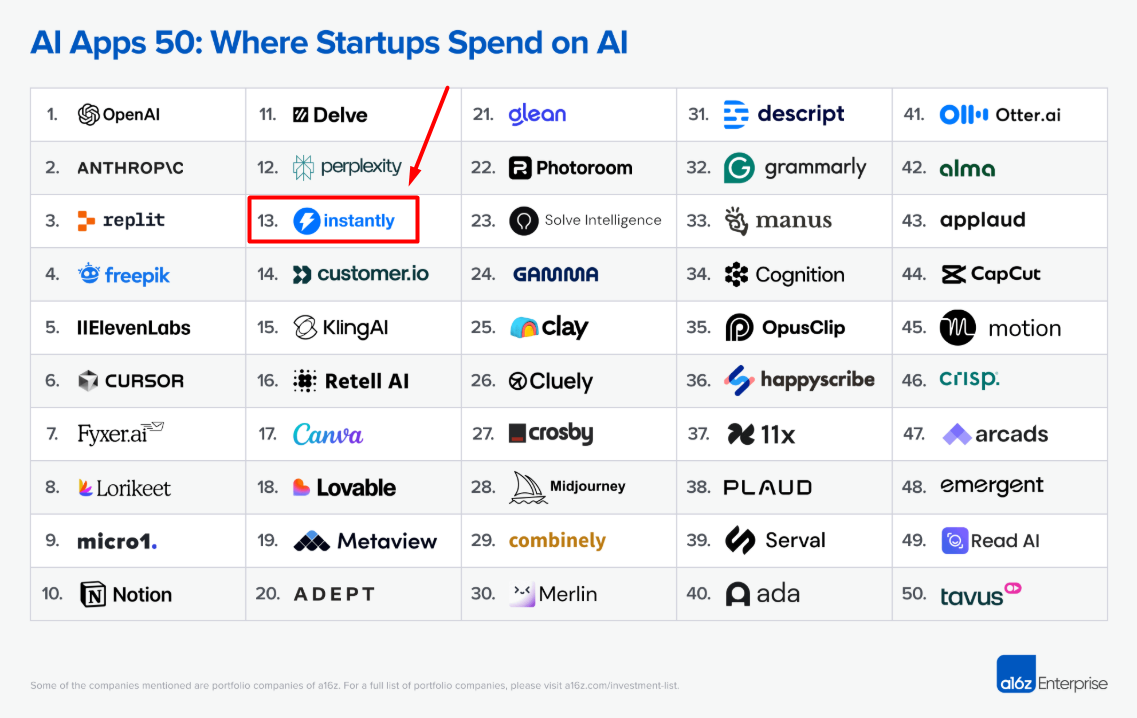
That’s why Instantly has become the go-to email automation tool for startups. Case in point, Silicon Valley venture capitalist firm A16Z listed Instantly as one of the 50 AI tools startups invest in.
Of course, using cold email marketing doesn’t mean you should ignore other strategies. You need a holistic roadmap for getting new customers. So, how do you run a cold outreach campaign at scale without scaling costs? What other methods can you use, and what tools do you need? We break it down below.
Why is Cold Email the Best Channel for Finding New Customers
The old playbook said to build the product, grow the brand, and sell. Today, you can do these in parallel. Cold email lets you reach decision makers, test offers, and book conversations while your product and brand mature. It gives you speed, control, and precise targeting.
Cold email also supports brand and community work. Use it to invite prospects to content, demos, and forums, then nurture those relationships over time. It works best when your ICP is tight, your value is clear, and your lists are verified. On top of this, cold email also lets you:
- Iterate fast: A/B test Subject lines, angles, CTAs, and improve campaigns based on data.
- Personalize at scale: Create hyper-personalized copy for every lead with enrichment.
- Multi-thread accounts: Reach multiple stakeholders to reduce single-champion risk.
- Activate intent: Target accounts showing search, tech, or event signals.
- Fill the calendar on demand: Sequence touches to turn replies into demos and meetings.
How to Find New Customers for Your Startup Using Cold Email
Cold email is the fastest way for startups to see real sales conversations. But with email service providers tightening outreach rules, agencies and cold email marketers are already seeing deliverability hits. The good news is that the restrictions are actually a net positive.
That just means the cold emails that land inside inboxes provide real value. Teams are still winning, scaling, and growing fast. If you want to emulate their wins, here’s a quick rundown of what you need to do:
Have a Solid Cold Email Infrastructure
In most guides, the recommendation is always the importance of your cold email infrastructure. That means setting up DMARC, DKIM, and SPF.
It can get technical and become a hassle to set up email accounts at scale. To help, Instantly offers a Done-For-You (DFY) email setup service for something more streamlined.
B2B Data Quality Defines Your Campaign
Modern cold emailing gets rid of static templates and playbooks. What matters most is “what matters most” to your prospect. To find out what that is, you’ll need enriched lead data. That’s where platforms like Clay come in. More data = better personalization and more value.
A popular combination startups use is Instantly for outreach automation, Apollo for lead generation, and Clay for enrichment. But if you want everything inside one dashboard, Instantly SuperSearch has over 450M pre-verified leads, and enrichment and research features.
Intent Beats Volume
Intent beats volume. Blasting anyone on a list burns reputation and SDR time. Segment deliberately by use case, role, and readiness, then treat replies according to intent.
Prioritize people who show real buying signals and park tire-kickers in nurture. If demos aren’t converting after trials, it’s usually weak intent entering the pipeline.
One strategy is to create intent tiers that guide SDRs. For example, tier 1 includes prospects who frequent your pricing pages, ask for a quote, or have a pain point you can fix. Tier 2 could be prospects who engage with your content. Then, tier 3 would be cold prospects.
Implement Lead Scoring
Lead scoring keeps intent ahead of volume. It tells you who to contact, how to route them, and how to respond. Without it, you burn domain reputation and waste SDR time. Assign points to the signals that predict revenue.
Example: +20 ICP match, +15 pricing-page visit, +10 relevant tech, +10 recent funding, −20 role-based or catch-all. Set a cutoff and only email contacts that clear the threshold.
Send Tier 1 to an AE fast lane with a short sequence and a direct booking CTA. Give Tier 2 educational content plus a light CTA, such as an audit. Exclude Tier 3 or remove them from your lists.
Match Unique Value Propositions to Intent
Unfortunately, most startups probably aren’t Frodo, and you don’t have the one value proposition to convert them all. Different intent levels need different asks. For example, you can lower friction for colder prospects or give higher commitments for sales-ready leads.
Intent Tier Framework
| Intent tier | Signals you see | Best next offer | CTA examples |
|---|---|---|---|
| Tier 1: In-market | Pricing questions, timeline, live pain, visited pricing | Pilot with a success plan, custom demo, ROI model, and security review | "Book a 20-minute pilot kickoff." "Share your data for a custom ROI." |
| Tier 2: Problem-aware | Engaged content, relevant tech stack, hiring for use case | 5-minute teardown, benchmark, mini ROI calc, case study | "Get a 5-minute teardown." "See how you stack up." |
| Tier 3: Cold | ICP fit only, no signals | Ungated playbook, template, calculator, on-demand webinar | "Grab the 7-step playbook." "Copy the template." |
Measurement and Guardrails
One reason startups burn time and money on extra domains and inboxes is that they try to scale before they can measure. The fix is a short list of email marketing and sales metrics, clear thresholds, and a playbook for when things go unplanned. Measurement tells you when to push, and guardrails tell you when to pause.
Instead of vanity metrics like open rates, focus on data that helps predict revenue. ESPs' privacy signals distort that signal. To get a more accurate reading, focus on these metrics:
- Positive reply rate: replies that show interest ÷ delivered emails.
- Meetings per 1,000 sends: booked calls ÷ total sends × 1,000.
- Time to first response: minutes from prospect reply to your human reply.
- Demo-to-close and pilot-to-paid: conversion through the funnel.
- Revenue per 1,000 sends: closed-won revenue normalized by volume.
- Health signals: hard bounce rate, complaint rate, deferrals, spam-folder seed placement.
Deliverability Maintenance is a Must
Aside from revenue signals, every startup needs to monitor deliverability. If deliverability slips, you buy extra domains and inboxes without fixing the root cause. Treat it as an ongoing system you maintain instead of a one-time setup.
- Verify and dedupe lists before sending, remove role-based and catch-all emails, and enforce a global suppression list so bounces and unsubscribes never re-enter your lists.
- Control sending patterns by spreading volume across the workday, capping per-inbox daily sends, respecting time zones, and only increasing limits after clean seed tests.
- Write deliverable emails with one clear idea, light HTML plus a plain-text version, few links, no URL shorteners, a real signature, and a simple one-click opt-out.
- Rotate creatives and trackers by swapping opener, relevance, value, proof, and ask lines, and rotating tracking domains so filters do not fingerprint your campaigns.
- Test and monitor with thresholds by running seed placement tests, watching bounces, complaints, deferrals, and spam seeds daily, and pausing to fix issues if complaints exceed 0.1% or spam seeds rise.
Let Instantly Handle the Heavy Lifting
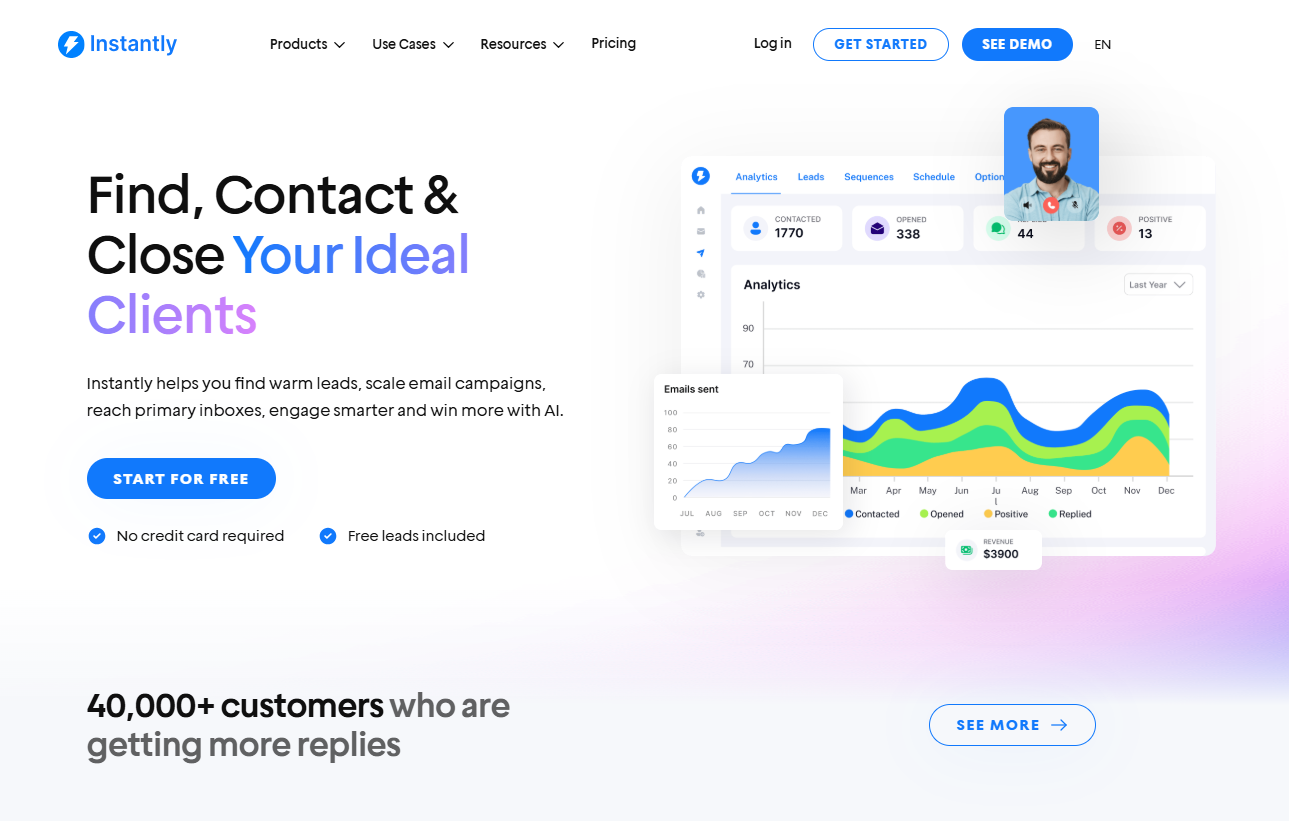
Instantly aims to make cold email accessible to every business, whether you’re an enterprise sending millions monthly or a startup looking for its first customers.
With Instantly, you can buy domains, get verified leads and enrich data, and track everything with our CRM. Everything a startup needs to get momentum rolling is purposely built inside one platform.
You can automate personalization using {{custom variables}}, find prospects similar to existing clients with our Lookalikes filters, and use AI lead filtering to help SDRs prioritize efforts.
Fundamental Strategies Startups Use to Find New Customers
Cold email is the fastest and easiest way to find new customers for your startup. But it should still be paired with strategies that help you build a brand, gather inbound leads, and create long-term demand. Here are the fundamental strategies you shouldn’t skip:
Content Marketing and SEO
Creating high-quality, informative content is one of the best ways to showcase your value to the market. It proves that you understand customer pain points and have the expertise to solve them.
Although content marketing and SEO are long-term strategies, they compound over time, help you build authority in your space, and get consistent inbound leads.
Paid Acquisition Strategies
Paid acquisition is a direct way startups can capture demand. Unlike organic strategies, it gives you immediate visibility and a direct pipeline of prospects. The problem is, paid channels get expensive fast if targeting and offers aren’t tight.
You can start with bottom-of-funnel campaigns by bidding on problem-aware and competitor terms, with the highest conversion rates. Use tight ICP filters to only pay for impressions from decision-makers who fit your market.
Every ad should send traffic to a strong landing page that mirrors the ad copy, answers the buyer’s question, and drives one clear CTA. Track CAC against CLTV and payback period to ensure campaigns are profitable before scaling.
Partnerships and Integrations
Partnerships give startups distribution, trust, and co-marketing you cannot buy. You can expand your reach, build your network, and help create a community around your brands.
For example, Instantly and Clay have run multiple joint masterclasses teaching founders how to wire enrichment to outreach and land more replies. Both teams document the integration end-to-end. You can see co-hosted “Clay + Instantly” webinars on YouTube, Instantly’s help guide for connecting Clay to campaigns, and Clay’s integration docs.
Customer Referrals
Referrals are one of the most cost-efficient growth loops a startup can build. Instead of constantly chasing new leads, you can turn every happy customer into a source of new opportunities. But to make referrals work at scale, they must be intentional. Here’s how:
- Make it simple: Offer customers a one-click forward email or a personal referral link. The easier it is to share, the more often it happens.
- Tie to customer success: Ask for referrals right after a milestone (e.g., a pilot success, a positive onboarding, or hitting ROI metrics).
- Reward both sides: Offer incentives that benefit the referrer and the new customer (e.g., account credits, discounts, or exclusive features).
- Personalize the ask: Tailor referral requests to the customer’s experience: “We helped you cut {{metric}} in half—do you know anyone else who could use this?”
- Track and attribute: Use referral software or CRM tagging to ensure every referral is logged, rewarded, and measured against revenue.
Community and Brand Building
Community is one of the most critical assets a startup can build. Products and features will evolve, but a strong community keeps your startup relevant, resilient, and positioned to grow into something bigger than the founding team.
A thriving community creates a positive feedback loop: early adopters share their wins, new users join to avoid FOMO, and the collective input helps shape a better product. Instantly leans heavily on community and feedback.
We’ve co-hosted events, collaborated with partners like Clay, and kept open channels where users can showcase workflows and pain points.
Many of our most popular features, such as improved deliverability tools and SuperSearch filters, came directly from listening to what the community wanted.
That ongoing dialogue strengthens the sense of belonging, showing that Instantly is more than just a company; it’s a movement of founders, marketers, and businesses building together.
Key Takeaways
Finding new potential customers is the easy part. The hard part is getting them interested enough to convert. That’s why the most successful startups combine outbound speed with inbound trust, and use discipline to protect deliverability and scale.
- Cold email works fastest for starting conversations, but it has to be paired with brand, inbound, and community strategies for sustainable growth.
- Infrastructure and deliverability guardrails keep you from burning domains and wasting budget on new setups.
- Quality data and intent scoring ensure your campaigns focus on genuine buyers, not tire-kickers.
- Tailored offers matched to buyer intent move prospects smoothly from awareness to conversion.
- Community and partnerships create long-term resilience, building trust loops that feed every other channel.
If you want to scale fast using cold email marketing, there’s no better tool for startups than Instantly.ai. Try it for free today.


