


AI agents are programs that perceive their environment, make decisions, and take actions.
The main types include reactive agents (simple responses), model-based agents (use internal memory), goal-based agents (act toward objectives), utility-based agents (choose the “best” option), and learning agents (improve over time).
Each has distinct strengths, from automating simple tasks to powering adaptive tools like Instantly’s AI Copilot.
Most people hear “AI agent” and tune out. Can you blame them? The term gets tossed around in investor decks and product webinars, but no one walks into a meeting and says, “Let’s deploy a model-based reflex agent before lunch.”
Still, these things are everywhere. The inbox that only lets the real stuff through, the bot that cancels your subscription with less attitude than a human rep, the scheduling tool that never double-books you. Each one is an agent doing a job.
This is happening right now. If you run a business, you bump into AI agents every day. So let’s pin down what they are, what makes them work, and which types you should care about before someone tries to sell you “AI-powered” whatever for the fifth time this week.
What Makes an AI Agent?
Most tech explainers would have you believe an AI agent is a brain in a box, plotting your next calendar appointment. Let’s put that aside. Strip it down, and an AI agent is a piece of software that gets inputs (emails, clicks, requests), figures out what those mean, and then does something about it.
Think of them as the digital equivalent of someone who notices your coffee cup is empty and refills it without you asking.
Some work off simple rules, some learn over time, and a few even set their own goals. Put simply, an agent senses what’s happening, decides what matters, and acts on it.
Why Businesses Care About AI Agents
Some tech trends are easy to ignore until you realize you’re falling behind while your competition quietly outsources the chores you still handle by hand. That’s the deal with AI agents.
Agents work around the clock with zero drift or distractions. That means no late-night lead follow-up, missed tickets, or half-hearted data entry. All the tasks that eat up bandwidth get reassigned to software, while your team does the work that brings in revenue.
This isn’t some far-off promise. Look at your calendar, your helpdesk queue, or your last automated email, and you’ll see an agent already there, getting it done.
Types of AI Agents
AI agents come in all shapes, but a handful of core types keep popping up across the business world.
Some are blunt instruments, some are quick studies, and a few try to do everything short of making coffee. Chances are, your stack mixes several, whether you know it or not. Let's briefly go over the main classifications.
Reactive Agents
These are the rule-followers of the bunch. Reactive agents see a signal, fire off a response, and reset for whatever comes next. No memory, no context, no second-guessing.
Your spam filter fits this mold: it checks every email against a playbook and takes action. Same for AI chatbots that stick to simple scripts or tools that auto-label incoming tickets.
They shine where instant decisions and zero ambiguity matter most. That said, don’t expect them to adapt. They’ll give you the same answer every time until the rules change without warning.
Model-Based Reflex Agents
Step up from reactive, add a little short-term memory, and you get model-based reflex agents. They still follow a playbook, but they keep notes on what happened, like a chatbot that remembers you already gave your order number, or a climate system that knows it recently cranked the AC five minutes ago.
You’ll see these agents in places where simple reactions fall short, like customer service bots that can handle a two-step problem, warehouse systems that need to avoid repeating the same path, or even security monitoring setups that notice if something “off” occurred.
Model-based reflex agents are a sweet spot for businesses that want a touch of context without building a full-blown thinking machine. They’re still fast, still focused, but a little less robotic about it.
Goal-Based Agents

This is where agents start thinking in terms of outcomes, not just reactions. Goal-based agents don’t just follow a script. They pause, check what’s happening, and map out a plan to reach a specific result. If something changes mid-process, they can pivot instead of getting stuck.
You’ll notice these in action any time you get dynamic route suggestions from a maps app, or when scheduling software lines up a dozen moving parts without breaking a sweat. These agents are built for scenarios where the destination matters, and the path can change on the fly.
In practice, goal-based agents show up anywhere you’ve got moving pieces: logistics, scheduling, operations, you name it. They’re the ones who react and work backwards from the end goal and map out how to get you there, no matter how many curveballs pop up along the way.
Utility-Based Agents
Goal-based agents pick a destination, but utility-based agents ask, “What’s the best possible outcome here?” Instead of only getting you from point A to B, they weigh every option, try to balance priorities, and go for the move that gives you the most value. That might mean speed, cost, comfort, or whatever else you care about in a given moment.
You’ll see utility-based agents behind dynamic pricing engines, smart energy management, or even tools that assign support tickets to the right rep. They shine when there’s no single “right” answer and you want something that adapts on the fly.
In the real world, these agents get used by teams who need to make tradeoffs between cost and speed, efficiency and accuracy, or different customer needs, without endless back-and-forth.
Learning Agents
Now we’re in territory where things start to feel less predictable, in a good way. Learning agents are built to improve themselves as they go, tweaking their approach based on patterns and feedback. They aren’t stuck with yesterday’s playbook. If the world changes, they keep up.
You see these in product recommendations that get sharper over time, fraud detection systems that spot new scams before they’re mainstream, or sales/marketing tools that personalize outreach based on every prospect’s latest action.
Anything that adapts to new data instead of following a script is probably powered by a learning agent. For businesses, these agents are the difference between “set it and forget it” and “gets better the longer you use it.”
Instantly Copilot and the New Wave of Specialized Business Agents
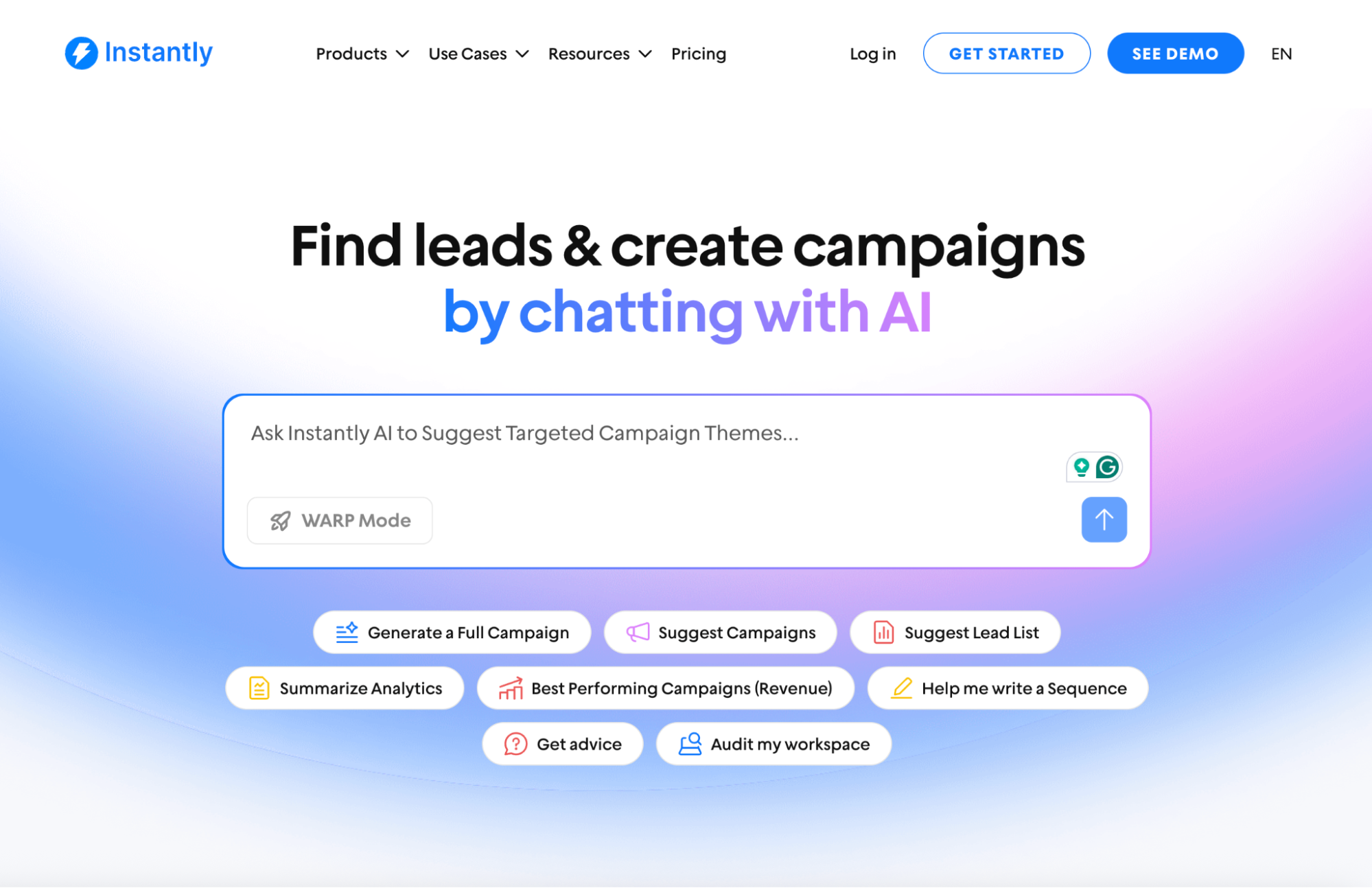
Not every agent fits neatly into the textbook categories, especially when it comes to sales and marketing. Many are designed around the everyday realities of business, blending elements from multiple agent types to solve specific problems.
Customer agents, for instance, handle tasks like ticket routing, chat support, and automated follow-ups so teams can stay responsive without burning out. Employee agents, on the other hand, streamline repetitive chores like onboarding, scheduling, and admin, so operations keep moving.
And then there are sales-focused agents built for outreach at scale. This is where Instantly’s AI Copilot stands out.
Instead of juggling tools, Copilot lets you launch campaigns, qualify leads, and even summarize analytics all through a simple chat interface. It combines the adaptability of a learning agent with the precision of a sales assistant to remove the manual grind while keeping outreach sharp and personal.
If you want to see what a business agent built for sales really looks like, try Instantly’s Copilot and experience how it turns cold outreach into a system that works for you. Try it today.
Key Takeaways
AI agents are already sorting, tagging, flagging, and making half your team’s job a little less painful. These tools free up sales and marketing teams from all the digital drudge that sometimes makes the profession a drag.
- Quick, rigid jobs? Hand them off to reactive or model-based agents and watch the brainpower bottlenecks disappear.
- Need strategy, real-world tradeoffs, or on-the-fly decision-making? That’s goal-based and utility-based turf.
- When you want your sales stack to adapt, personalize, and handle more than a Monday inbox, point the learning and business agents at the problem and let them fight it out.
Want to see what happens when you stop doing it all yourself? Start your free Instantly trial.


