

Updated June 16, 2026
TL;DR:
Use cases covered: throughput scaling without new reps, event attendee follow-up, competitor customer targeting, inbound lead qualification, and enterprise ABM. AI SDRs handle list building, enrichment, sequence drafting, and reply triage so reps focus on closing. Teams using Instantly's $141/month starter stack replace the $102,000-$145,000 fully loaded annual cost of a single in-house SDR. These agents require deliverability infrastructure to work safely: unlimited inboxes, automated warmup, and sends capped at 30 per inbox per day.
Sales teams not using AI SDR use cases as an operational framework are manually executing tasks that AI agents can handle faster and at greater scale. The gap between teams running automated, deliverability-first outbound systems and those grinding through spreadsheets is widening fast.
If you are a sales leader or agency operator looking to scale outbound without adding headcount, this guide covers the five use cases worth deploying first.
This guide breaks down five proven AI SDR use cases, the performance metrics that matter, and the deliverability guardrails required to protect your brand reputation while scaling.
Core capabilities behind AI SDR use cases
Before examining the use cases, it helps to understand where AI SDRs fit within a structured pipeline execution framework. Every outbound motion moves through four operational stages:
- Prospecting: Build and segment prospect lists from a target account universe, identify ICP-fit contacts, and generate initial engagement.
- Enrichment: Layer verified firmographic and technographic data onto raw leads, fill missing fields, and score contact quality before any send.
- Qualification: Assess reply intent, route engaged leads to humans, and suppress unqualified contacts from further sequencing.
- Booking: Confirm interest, handle objections, and schedule a first meeting or discovery call.
Instantly's three documented AI agents each operate across specific stages of this framework. The table below shows how they map.
Instantly AI agent comparison
Agent | Primary trigger | Key data sources | Primary action |
|---|---|---|---|
Campaign launch or lead list upload | SuperSearch, enrichment providers | Sources leads autonomously, sequences prospects, tracks replies | |
Incoming reply received | Unibox, CRM, reply content | Classifies and triages replies in under 5 minutes | |
User prompt or scheduled task | Websites, PDFs, ICPs, and custom rules | Drafts sequences, summarizes analytics, runs recurring tasks |
Use cases split into two practical categories.
- Quick wins: List cleaning, basic follow-up sequences, out-of-office detection, and reply classification. These are low-risk, fast to implement, and deliver immediate time savings.
- Complex use cases: Multi-signal intent tracking, buying committee mapping, competitor displacement campaigns, and event-triggered ABM. These require richer data inputs and more deliberate sequence governance.
How AI SDRs differ from traditional automation
Traditional automation tools operate on rule-based logic. If a contact opens an email, wait two days, then send email two. If a contact clicks a link, tag them as interested. The system can only act on what a form explicitly captures, and the ceiling on personalization is low.
LLM-driven AI agents work differently, reading free-text inputs and inferring intent, company context, and buying stage from natural language rather than relying on structured form fields. This creates the Human + AI Hybrid Model that high-performing sales teams build in 2026: AI handles administrative, repetitive tasks (list building, enrichment, sequence drafting, A/Z testing, first-pass reply triage), while humans handle discovery conversations, complex objection handling, and final close. The Instantly AI Sales Agent puts this model into practice by handling autonomous lead sourcing and outbound execution, leaving reps to focus entirely on qualified pipeline.
Key metrics for AI SDR performance
Track these four metrics to evaluate your AI SDR deployment.
- Primary inbox placement rate: The percentage of sends landing in the primary inbox rather than spam or promotions. Google recommends keeping your spam complaint rate below 0.1% for consistent inbox placement, and bulk senders of 5,000+ daily emails must authenticate with DKIM, SPF, and DMARC.
- Bounce rate: Keep total bounce rate at or below 1% per campaign. Hard bounces should stay below 0.5% for new domains. If bounce rate climbs above 1%, pause the campaign, re-verify your list, and restart at a lower send cap. Instantly flags high-bounce campaigns automatically so you catch the problem before it damages your domain reputation.
- Reply-to-meeting conversion rate: The percentage of positive replies that become booked meetings. AI-driven nurture sequences outperform static, rules-based drips because relevance compounds with personalization depth.
- Cost per meeting: Divide total monthly platform and labor costs by meetings booked. This is the CFO-facing metric that justifies the investment.
Cost-per-meeting comparison
Model | Monthly cost | Meetings booked (est.) | Est. cost per meeting |
|---|---|---|---|
1 in-house SDR (fully loaded) | $8,500-$12,083+ | Varies by rep and market | Varies by performance |
Instantly starter stack (Outreach + Credits + CRM) | ~$141 | Varies by campaign | Varies by campaign and reply rate |
Instantly power stack (Light Speed + Instantly Credits) | Varies by campaign | Varies by campaign and reply rate |
In-house SDR fully loaded annual cost estimated at$102,000 - $145,000annually based on 2026 benchmarks.
Table 3: AI-led vs. human-led conversion rates by use case
Use case | Human-led reply rate | AI-led reply rate | Human reply-to-meeting | AI reply-to-meeting |
|---|---|---|---|---|
High-volume outbound prospecting | Varies by list quality | Varies by setup | Varies by campaign | Varies by campaign |
Event attendee follow-up | Higher intent segment | Higher intent segment | Varies by campaign | Varies by campaign |
Competitor customer targeting | Varies by account and trigger | Varies by account and trigger | Varies by campaign | Varies by campaign |
Inbound lead qualification | Higher engagement rates | Higher engagement rates | Varies by qualification process | Varies by qualification process |
AI-led rates reflect speed-to-lead advantages (under 5 min response) and dynamic personalization vs. manual processes that typically respond slower. Competitor displacement conversion rates vary significantly based on intent trigger quality, targeting precision, and sequence governance. No independently verified 2026 benchmarks exist for this segment.
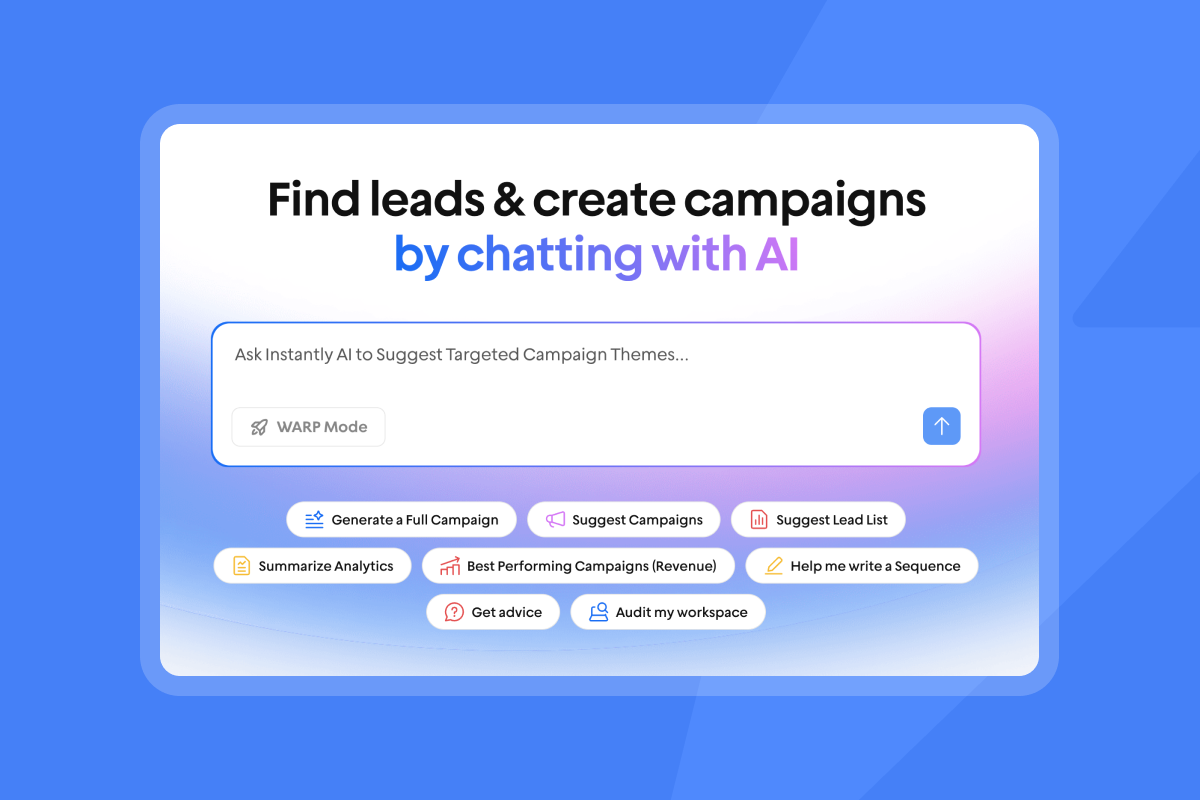
Use case 1: Scaling email throughput without new reps
The most common scaling problem in outbound is a gap between pipeline targets and approved headcount. Adding reps is slow and expensive. Pushing more volume through existing domains raises bounce rates and damages sender reputation. The correct move is to distribute volume across more inboxes while keeping sends per inbox within safe limits.
Scaling volume without hiring more reps
Capping sends at 30 per inbox daily is the foundational rule. Beyond that threshold, spam risk increases sharply. To send 300 emails per day safely, connect 10 warmed inboxes and rotate sends across them.
With Instantly's flat-fee Outreach Growth plan at $47/month, you connect unlimited email accounts across as many secondary domains as your volume requires, with no per-seat cost for adding inboxes. A team running 50 secondary domains at 30 sends each produces 1,500 daily touches for the same flat fee that a per-seat platform charges for a single rep's account. Apollo's SMTP mailbox connections are capped at 15 per user when on their Organization plan.
How AI SDRs automate prospecting sequences
Once the infrastructure is in place, the AI Sales Agent and Copilot handle copy and sequence work.
- Sequence creation: Copilot drafts multi-step sequences based on your ICP definition and enrichment data, including spin syntax to vary wording across sends.
- A/Z testing: The Growth plan includes A/Z testing, and the Hypergrowth plan extends this to up to 26 variants per sequence step. More variants mean more copy diversity across sends, which reduces the risk of ISPs detecting repeated identical patterns and routing campaigns to spam.
- Send-window optimization: Campaigns schedule around peak engagement windows for each recipient's time zone, improving open rates without increasing volume.
- Deliverability testing: The Growth plan includes a send deliverability test from the preview window, so you catch inbox placement issues before a campaign goes live.
Sales teams that replace manual SDR volume with AI agent-driven outreach reduce pipeline generation costs. The inputs that drive this reduction are consistent send-per-inbox discipline, automated list hygiene, and bounce detection. Track bounce rate by campaign daily, flagging any campaign above 1% and pausing before it damages domain reputation.
Use case 2: Converting event attendees to SQLs
Event leads are among the highest-intent contacts in any pipeline. They've already allocated time to engage with your category. The conversion window is short, typically 48-72 hours post-event, and most sales teams miss it because manual follow-up can't move fast enough at scale.
A typical post-event process: a rep receives a spreadsheet of attendee names, manually researches each contact, writes a personalized note, and sends it one by one. With 200 attendees, that process takes days. By day three, the leads are cold.
Companies that contact leads within 5 minutes are 21x more likely to qualify them versus those who wait 30 minutes. The industry average response time is 42 hours. The cost of that delay isn't just missed meetings. It's the total ROI on your event sponsorship that evaporates while the spreadsheet sits in someone's inbox.
Automated personalization for attendee lists
The practical workflow using Instantly's platform:
- Upload the attendee CSV to Instantly and run waterfall enrichment across 5+ providers to verify emails and add firmographic and technographic context.
- Use Copilot to build an event-specific sequence with dynamic variables referencing session names, speakers, or topics relevant to each contact's function.
- Cap sends at 30 per inbox per day across your sending account pool and launch within hours of the event closing.
Teams using this workflow report booking meeting benchmarks consistent with Instantly's published case data of 15 demos in 10 days by combining enriched lists with automated sequences. The AI handles enrichment and personalization at scale. Human reps take over once a positive reply comes in.
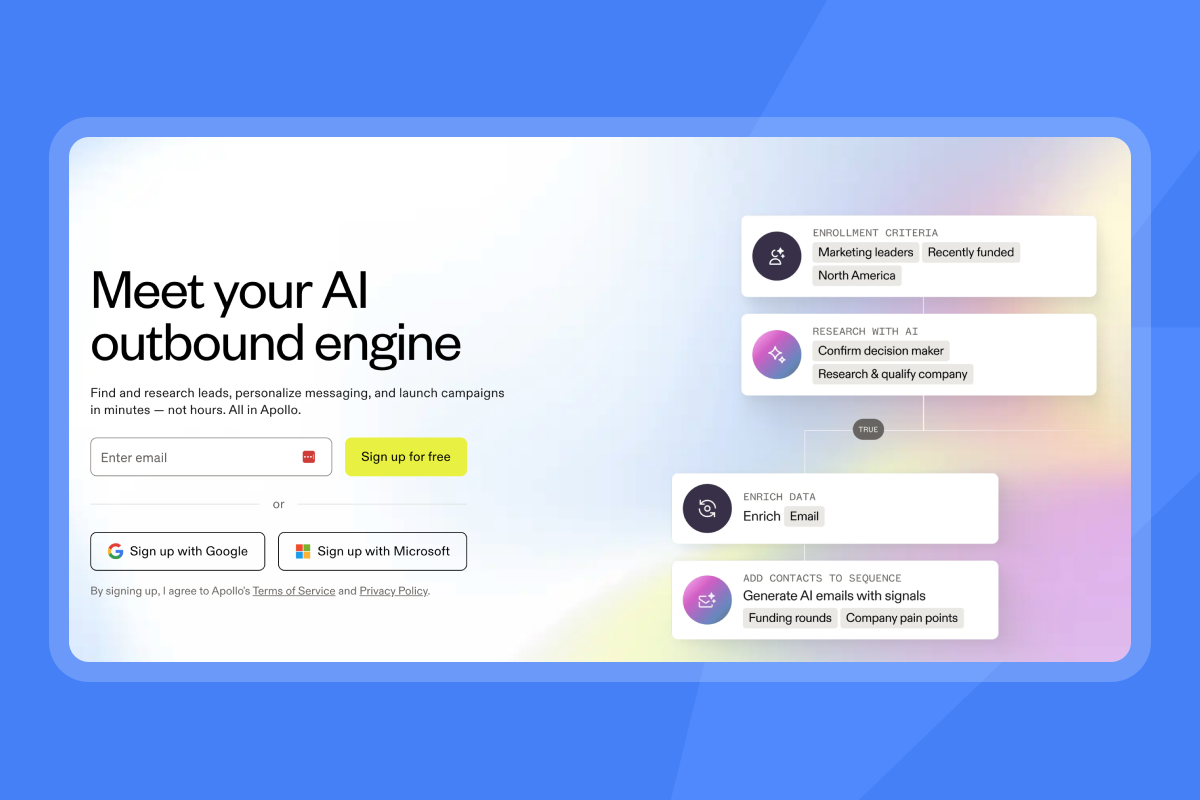
Use case 3: Targeting competitor customers
Competitor displacement is one of the highest-value AI SDR use cases because the targeting is precise, the intent signals are clear, and the messaging differentiates with specific proof points. The challenge is identifying the right accounts at the right moment.
High-intent triggers to watch:
- Technology stack changes: When a company replaces or adds a key platform adjacent to yours, it signals active evaluation of their toolset.
- Leadership changes: A new Head of Sales or VP of RevOps at a competitor account often means the incumbent tool gets re-evaluated.
- Public complaints: Review site patterns and community posts signaling dissatisfaction with a competitor's pricing or reliability are actionable triggers.
Inside SuperSearch, apply technographic filters to isolate companies where your target competitor appears in their confirmed tech stack. This list becomes your displacement campaign audience. The secondary domain strategy is especially important here because displacement campaigns require more personalization and more sequence steps, which means longer per-contact engagement. Distribute these sends across dedicated secondary domains rather than primary domains to protect your core sending reputation.
For teams on the Light Speed plan, SISR (Server and IP Sharding and Rotation) automatically assigns dedicated private server and IP blocks to your campaigns, removes shared IP risk, and rotates flagged IPs without pausing active sends.
The AI Sequence Writer inside Instantly drafts displacement-specific sequences using your ICP definition, competitor context, and enrichment data. Lead with the trigger that flagged the account, anchor to specific proof (meetings booked, cost per meeting), and keep the first ask small: a 15-minute call, not a full demo. The Instantly Prompt Library includes community-contributed frameworks the AI Sequence Writer can adapt to your specific differentiators.
Use case 4: Inbound lead qualification and routing
Your inbound leads arrive with higher intent than cold outbound prospects, but they expire faster. A form fill or trial signup that doesn't hear back within minutes often converts with a competitor who responds first.
Contact attempts within 5 minutes make you 100x more likely to reach the lead and 21x more likely to qualify them. Most teams respond well outside that window, which means they're operating at a fraction of possible conversion on their own inbound traffic.
Prioritizing leads with AI scoring
Before routing, the AI scores each inbound lead using enrichment data. Weight your scoring model against:
- ICP fit: Company size, industry, and revenue range.
- Technology stack alignment: Does the company use complementary tools?
- Engagement depth: Trial activity, pages viewed, content downloaded.
- Contact seniority: Decision-maker or end-user?
Leads above a defined threshold route directly to AE sequences. Leads below enter a nurture track.
Accelerating pipeline with clean handoffs
The critical failure point in most inbound workflows is the CRM handoff. Your AI classifies a lead, your rep books the meeting, and then you discover the CRM record is missing data, duplicated, or tagged incorrectly. This breaks attribution and makes pipeline reporting unreliable.
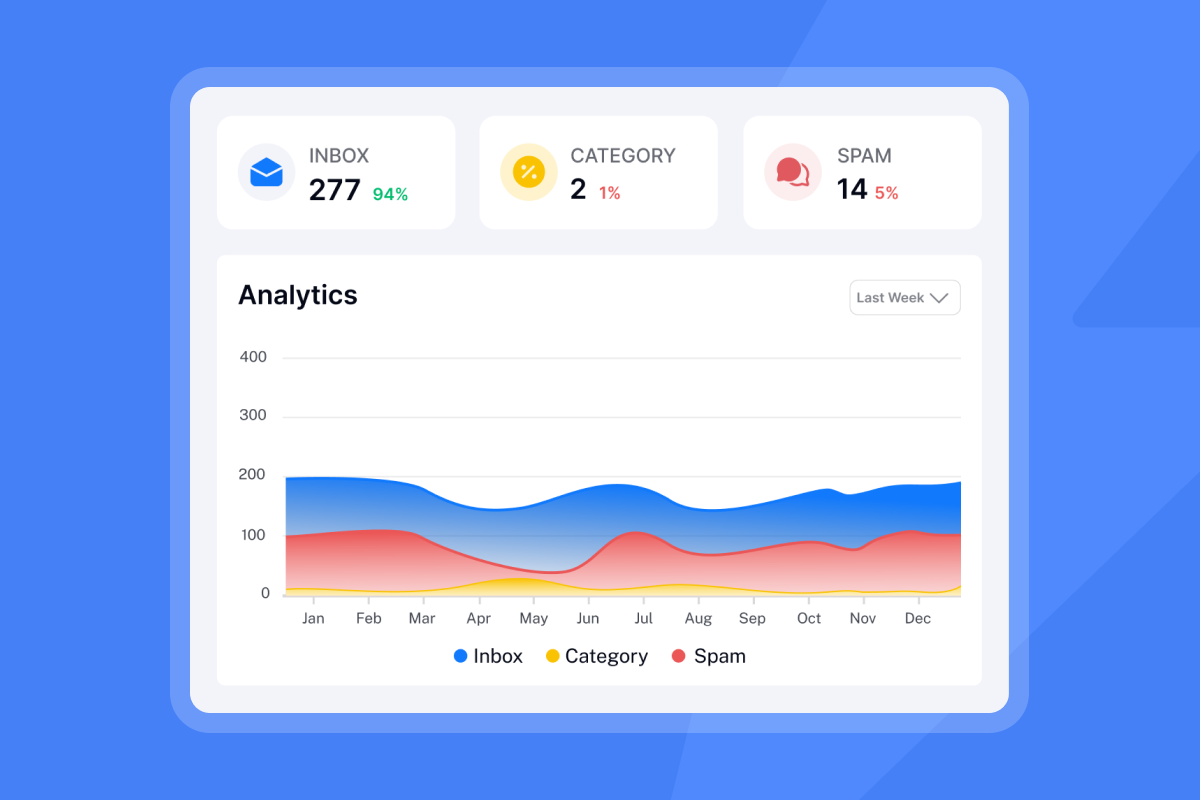
Use case 5: Personalizing enterprise account outreach
Enterprise ABM campaigns fail for two reasons: you reach too few stakeholders, and you send generic messaging that doesn't speak to each function's priorities. The buying committee at a 500-person company includes IT, Finance, Security, and the business unit leader, and each one needs a different value narrative.
Automating outreach to buying committees
SuperSearch's 450M+ lead database lets you build separate segments for each buying committee function at a target account and enrich them with verified contact data before a single email goes out.
- IT/Engineering: Focus on integration reliability, data residency, and security posture.
- Finance: Focus on cost per meeting, ROI benchmarks, and contract flexibility.
- Operations/RevOps: Focus on CRM integration quality, data hygiene, and reporting accuracy.
- Business unit leader: Focus on pipeline impact, meetings booked, and time to first result.
Mapping AI sequences to target personas
The AI Sequence Writer generates copy variations for each persona based on enrichment context and the value narrative you define.
- Assign a sequence template per function (IT, Finance, Ops, BU leader) and set dynamic variables to pull in company-specific context such as recent funding or product announcements.
- Set A/Z test variants for subject lines per persona to identify which framing resonates best.
Key criteria for vetting AI SDR vendors
Every AI SDR platform claims they will improve your pipeline. The criteria that actually matter are deliverability architecture, governance controls, integration quality, and total cost of ownership.
Ensuring inbox placement and domain health
If a vendor doesn't operate its own deliverability infrastructure, they are reselling third-party sending capacity, which means your domain reputation is tied to their shared IP pool's behavior. Ask whether the vendor includes automated warmup with a real-account network, dedicated or private IP pools, and scheduled inbox placement tests.
Instantly's deliverability network includes 4.2M+ accounts used for warmup and engagement. Automated Inbox Placement tests run on a scheduled basis and alert you if primary inbox placement drops. SISR on the Light Speed plan provides dedicated private server and IP rotation, automatically reassigning flagged IPs without pausing live campaigns.
"The deliverability tools actually work, and their customer support is responsive when we've had questions. We're able to scale our outreach without sacrificing personalization or risking our sender reputation." - Natalie on Trustpilot
Standardizing team permissions and data
Without admin controls, individual reps configure their own sequences with inconsistent messaging, unsafe send volumes, and unapproved copy, creating compliance risk and destroying domain health. The controls a sales leader needs:
- Human-in-the-Loop mode: The AI Reply Agent drafts responses and routes them to Slack for rep approval before sending.
- Autopilot mode: For high-volume sequences where reply patterns are well-understood.
- Global block list: Excludes specific domains or contacts from all sequences across the entire team.
Instantly operates under a published DPA through Foo Monk LLC, with a public sub-processor list anchored on AWS (USA). For GDPR and CCPA compliance, you must ensure the contacts you upload were collected with appropriate consent. Instantly's operational controls support that posture but don't substitute for your own data sourcing practices.
Avoiding hidden costs in AI SDRs
Per-seat pricing models penalize you for growth. When you add sending capacity to scale volume, every new inbox becomes an additional license fee. Instantly's pricing separates infrastructure cost from AI agent cost. The Outreach Growth plan at $47/month covers unlimited sending accounts and warmup with no per-seat charge. AI agents (Copilot, AI Sales Agent at 5 credits per lead, AI Reply Agent at 5 credits per reply) run on a separate Instantly Credits subscription starting at $9/month, with a free 100-credit trial. You see exactly what the AI agent layer costs, and you scale each component independently.
A starter stack (Outreach Growth + Credits Growth + CRM Growth) runs approximately $141/month. A power stack (Light Speed + Instantly Credits) runs approximately $555/month. Compare that against the fully loaded cost of a single in-house SDR at $102,000-$145,000+ annually and the cost differential is clear.
Start with the 14-day free trial (no credit card required) to connect unlimited sending accounts and test the AI Sales Agent with 100 free Instantly Credits.
FAQs
Do AI SDRs reduce team headcount?
No. AI SDRs shift human focus from manual prospecting and list-building to high-value closing conversations. The most effective deployments use AI to handle the administrative workload, including list building, enrichment, sequence drafting, and reply triage, freeing the same headcount to cover more pipeline at a higher conversion rate.
How do you ensure inbox placement at scale?
Use secondary sending domains and cap sends at 30 emails per inbox per day across your sending account pool. Teams on the Light Speed plan get SISR, which provides dedicated private IP pools and automatic rotation without pausing active campaigns.
What does AI SDR cost per meeting look like?
A fully loaded in-house SDR runs $102,000-$145,000+ annually. An Instantly starter stack runs approximately $141/month and a power stack runs approximately $555/month, representing a substantial reduction in cost per meeting versus equivalent human SDR output.
How does Instantly's AI Reply Agent classify lead intent?
The AI Reply Agent processes incoming replies within 5 minutes of receipt and classifies each one (Interested, Meeting Booked, Not Interested, Out of Office, Referral, or Objection). It then updates the contact's status in Unibox and pushes the classification to HubSpot or Salesforce via OutboundSync, maintaining a clean CRM record without rep intervention.
Key terms glossary
Primary inbox placement: The percentage of emails landing in the main inbox tab rather than spam or promotions folders. Google recommends keeping spam complaint rates below 0.1% for consistent placement, with a hard enforcement threshold at 0.3%.
Sender reputation: A score assigned by ISPs based on sending patterns, bounce rates, spam complaints, and engagement metrics. Poor reputation routes emails to spam automatically.
Warmup: The process of gradually increasing send volume from a new email account while generating engagement signals to build positive sender reputation. Instantly's network uses 4.2M+ accounts for automated warmup.
SISR: Server and IP Sharding and Rotation, a deliverability feature on Instantly's Light Speed plan that assigns dedicated private IP pools and automatically rotates flagged IPs without pausing campaigns.
Throughput: Total email volume sent across all connected inboxes within a time period. Safe scaling caps individual inbox sends at 30 campaign emails per day.
Read next
- Boost SDR productivity: advanced automation & AI for outreach: How to use AI tools and automation to increase rep output without adding headcount.
- Cold email deliverability best practices: The sending rules, authentication setup, and hygiene habits that keep your emails landing in the primary inbox.
- How to use secondary domains for cold email safety: A step-by-step guide to setting up secondary domains so you can scale volume without risking your primary domain reputation.


